
It may interest you
-
 SN 2021lwz: Understanding an Unusual Stellar Explosion Discovery and Initial Mystery On May 10, 2021, astronomers detected a supernova called SN 2021lwz at a distance of approximately 900 million light-years from Earth. What made this event remarkable was its unusual behavior: it combined characteristics of different supernova types in ways that didn't fit established classifications, prompting an in-depth investigation. Why This Supernova Matters Supernovae are among the most energetic events in the universe, marking the violent deaths of massive stars. They help astronomers understandAdvertised on
-
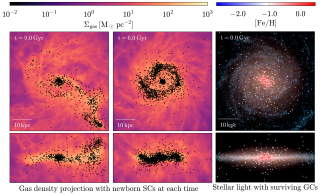 Globular clusters are dense, ancient groupings of stars that have survived the long history of galaxy formation and evolution, yet the exact processes that shape them from birth to the present day remain unclear. Here, we present AuriGLOBES (Auriga GLOBular clustEr Simulations), a new physical model designed to track how star clusters form and evolve within large-scale cosmological simulations. Using this model, we simulated nine galaxies similar in mass to the Milky Way and five lower-mass galaxies. Our simulations successfully produce realistic globular cluster systems that matchAdvertised on
-
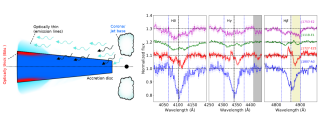 Low-mass X-ray binaries are systems in which a star transfers matter onto a compact object—either a black hole or a neutron star—producing energetic outbursts. During these events, their optical spectra provide a way to study extreme processes of accretion and matter ejection. While some spectroscopic features have been analysed in detail (e.g., revealing disc expansion and the presence of optical winds), the appearance of broad absorptions in the optical regime has traditionally been neglected. In this work, we present the first systematic study of these broad absorptions. We carry out theAdvertised on