The old, red stars that constitute the bulges of galaxies, and the massive black holes at their centres, are the relics of a period in cosmic history when galaxies formed stars at remarkable rates and active galactic nuclei (AGN) shone brightly as a result of accretion onto black holes. It is widely suspected, but unproved, that the tight correlation between the mass of the black hole and the mass of the stellar bulge results from the AGN quenching the surrounding star formation as it approaches its peak luminosity. X-rays trace emission from AGN unambiguously, whereas powerful star-forming galaxies are usually dust-obscured and are brightest at infrared and submillimetre wavelengths. Here we report submillimetre and X-ray observations that show that rapid star formation was common in the host galaxies of AGN when the Universe was 2-6 billion years old, but that the most vigorous star formation is not observed around black holes above an X-ray luminosity of 1044 ergs per second. This suppression of star formation in the host galaxy of a powerful AGN is a key prediction of models in which the AGN drives an outflow, expelling the interstellar medium of its host and transforming the galaxy's properties in a brief period of cosmic time.
Average star formation rates, (SFR), derived from averaged far-infrared luminosities of 1<z<3 AGNs, as a function of suLX.
Advertised on
References
It may interest you
-
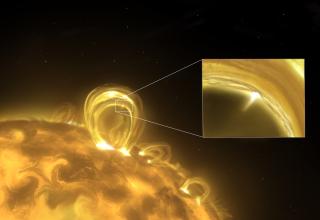
An international team of researchers led by the Instituto de Astrofísica de Canarias (IAC) and the Universidad de La Laguna (ULL), has unveiled a breakthrough explanation for the origin of tiny, jet-like plasma ejections in the solar atmosphere, known as “nanojets.” These elusive events which are recently discovered by the NASA’s solar telescopes are thought to play an important role in heating and sustaining the solar corona at temperatures above one million Kelvin. Why Study Nanojets? For decades, solar physicists have been puzzled by the so-called “coronal heating problem.” While the SunAdvertised on -
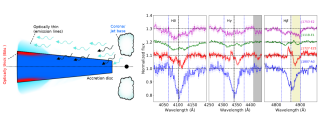
Low-mass X-ray binaries are systems in which a star transfers matter onto a compact object—either a black hole or a neutron star—producing energetic outbursts. During these events, their optical spectra provide a way to study extreme processes of accretion and matter ejection. While some spectroscopic features have been analysed in detail (e.g., revealing disc expansion and the presence of optical winds), the appearance of broad absorptions in the optical regime has traditionally been neglected. In this work, we present the first systematic study of these broad absorptions. We carry out theAdvertised on -
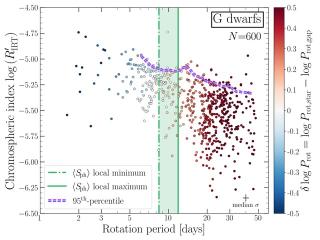
New study reveals enhanced magnetic activity across the stellar atmosphere after the intermediate rotation-period gap Stars change as they age. Like our Sun, they rotate and generate magnetic fields, producing phenomena such as dark spots on their surfaces and influencing the activity of their atmospheres. As stars age, they generally rotate more slowly and their magnetic activity declines. However, observations have revealed an unexpected feature in this evolution: a shortage of stars with certain intermediate rotation periods. This intermediate rotation-period gap suggests that stellarAdvertised on