News

This section includes scientific and technological news from the IAC and its Observatories, as well as press releases on scientific and technological results, astronomical events, educational projects, outreach activities and institutional events.

Displaying 1 - 6 of 319
Advertised on
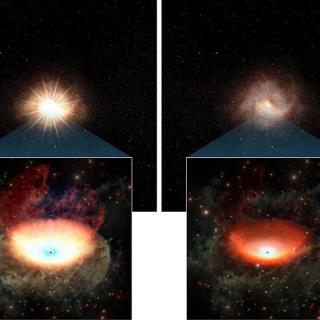
  • A comparison between the bright and faint phases of a supermassive black hole
    An international team of astronomers, including researchers from the Instituto de Astrofísica de Canarias (IAC) and the Gran Telescopio Canarias (GTC), has observed a dramatic change in a supermassive black hole. Located about 10 billion light-years away, the object dimmed to roughly one-twentieth of its former brightness in just two decades — an extraordinarily short interval on cosmic timescales. The discovery was made within a collaborative observing framework linking Japan’s Subaru Telescope with the GTC in Spain’s Canary Islands at the Roque de los Muchachos Observatory, in La Palma
    Advertised on
  • Laser launched from the Teide Observatory.
    The Instituto de Astrofísica de Canarias is designing and developing, as ordered by the Spanish company Thales Alenia Space , the adaptive optics which will be a parto f the ground station for the GARBO project, the first Spanish geostationary system for distributing quantum keys by satellite. This is a decisive step in the field of secure quantum communication on a large scale, and will strengthn the position of Spain, and of Europe at the Forefront of this technology. Within the framework of the project the IAC will lead the development of the adaptive optics systems, and will participate
    Advertised on
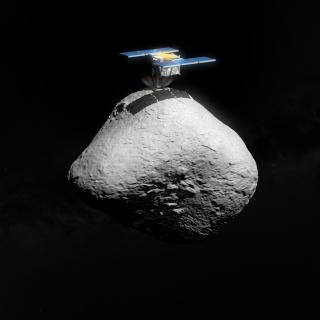
  • An artist's impression of Japan’s Hayabusa2 space mission touching down on the surface of the asteroid 1998 KY26.
    Astronomers have used telescopes around the world, includingthe Gran Telescopio Canarias (GTC or Grantecan) at the Roque de los Muchachos Observatory on La Palma, to study the asteroid 1998 KY26, revealing it to be almost three times smaller and spinning much faster than previously thought. The asteroid is the 2031 target for Japan’s Hayabusa2 extended mission. The new observations offer key information for the mission’s operations at the asteroid. “We found that the reality of the object is completely different from what it was previously described as,” says astronomer Toni Santana-Ros, a
    Advertised on
  • EIRIF technicians cut the brush to create an fire barrier in the close surroundings of the Roque de Los Muchachos Observatory on La Palma
    The teams of intervention and reinforcement for forest fires of the Government of the Canaries carried out trials at the roque de los Muchachos Observatory with participation by the Instituto de Astrofísica de Canarias On July 11th the Roque de los Muchachos Observatory was host to a very important trial relevant to the safety of the mountain tops of the Island of La Palma with participation by the Teams of Intervention and Reinforcement against Forest Fires (EIRIF) of the Canary Government, and the collaboration of the Instituto de Astrofísica de Canarias (IAC). The exercise centred on two
    Advertised on
  • 4th ESO students from the Santo Domingo de Guzmán school in La Palma during their visit to the GTC as part of the “Nuestr@s Alumn@s y el ORM” program.
    The outreach program "Our Students and the ORM," (“ Nuestr@s Alumn@s y el ORM”) aimed at schools in La Palma, is celebrating its 15th edition and is commemorating its 15th anniversary with unanimous recognition from its user community. This consolidated initiative of the Roque de los Muchachos Observatory (ORM) of the Canary Islands Institute of Astrophysics (IAC) has concluded this academic year with 100% satisfaction from the schools in La Palma that participated in this edition. This program seeks to bring font-line science and technology to the island's younger generations by involving
    Advertised on
  • El director del Instituto de Astrofísica de Canarias, durante el acto de conmemoración del 40 Aniversario / IAC
    El Instituto de Astrofísica de Canarias (IAC) ha celebrado, este jueves 24 de julio de 2025, el 40 aniversario de la inauguración oficial de su sede central y de sus dos observatorios. Un acto que ha estado centrado en destacar el trabajo de los cientos de personas que han contribuido a convertir el IAC en uno de los centros de excelencia investigadora y técnica más importantes del mundo. En el acto, el director fundador del IAC, Francisco Sánchez, ha tenido un papel fundamental pese a que sus problemas de salud no le hayan permitido participar en el mismo. El lema de este 40 aniversario ha
    Advertised on