Bibcode
Fernández-Valenzuela, Estela; Ortiz, Jose Luis; Holler, Bryan J.; Sicardy, Bruno; Rommel, Flavia L.; Vara-Lubiano, Mónica; Morales, Nicolas; Vachier, Frederic; Desmars, Josselin; Kretlow, Mike; Vieira-Martins, Roberto; Jehin, Emmanuel; Ferrais, Marin; Santos-Sanz, Pablo; Rustamkulov, Zafar; de la Vega, Alexander; Warner, Elizabeth; Benkhaldoun, Zouhair; Kamin, Roxanne; Ryan, Al; Earls, Bernie; Conti, Dennis; de Wit, Julien; Burdanov, Artem; Francini, Richard; Langill, Philip; Morales, Ruben; Fraser, Wesley; Kiss, Csaba; Pál, András; Souami, Damya; Lecacheux, Jean; Braga-Ribas, Felipe; Duffard, René; Alvarez-Candal, Alvaro; Benedetti-Rossi, Gustavo; Morgado, Bruno; Camargo, Julio I. B.; Júnior, Altair Ramos Gomes; Assafin, Marcelo; Aissa, Djounai Baba; Grigahcene, Zaki; Buie, Marc W.; Licandro, Javier; Alarcon, Miguel R.; Serra-Ricart, Miquel; Castro-Tirado, Alberto; Fernandez-Garcia, Emilio Jesus; Iglesias-Marzoa, Ramón; Galindo-Guil, Francisco J.; González, Hugo; Gonçalves, Rui; Rengstorf, Adam; Flynn, Randy; Olsen, Aart; Hanna, Bill; Barnes, Jason; A'Hearn, Joseph A.; Kreyche, Steven M.; Miller, William J.; Mortensen, Lillian E.; Gibson, Thomas C.; Walker, Gary; Stolle-McAllister, Gerogia; Feiden, Gregory A.; Froetschel, Joseph; Steel, Suzanne; Encardes, Destin; Fisher, R. Scott; Luken, Alton; Holcomb, Eric; Caton, Daniel; Dunford, Bob; Monin, Dmitry
Referencia bibliográfica
Nature Communications
Fecha de publicación:
12
2025
Número de citas
6
Número de citas referidas
5
Descripción
Stellar occultations, when a distant object passes in front of a star and casts a shadow on Earth, are a powerful tool to probe the physical properties of solar system bodies. They enable precise size and shape measurements and can reveal rings, satellites, atmospheres, or surface features. Here we present results from two stellar occultations by Hiʻiaka, dwarf planet Haumea's largest satellite, observed in April 2021. The second event yielded the first documented multi-chord occultation involving a trans-Neptunian satellite other than Charon. Combining these data with photometric observations, we find that Hi'iaka is a triaxial ellipsoid with a volume-equivalent diameter of 370 ± 20 km and a density of 640 ± 80 kg/m³, indicating a porous interior. The visible geometric albedo is 0.76±0.15, (∼30% higher than Haumea's). The combination of low density and rapid rotation (9.68 ± 0.02 hours), under the assumption of a homogeneous body, indicates that Hiʻiaka deviates from hydrostatic equilibrium.
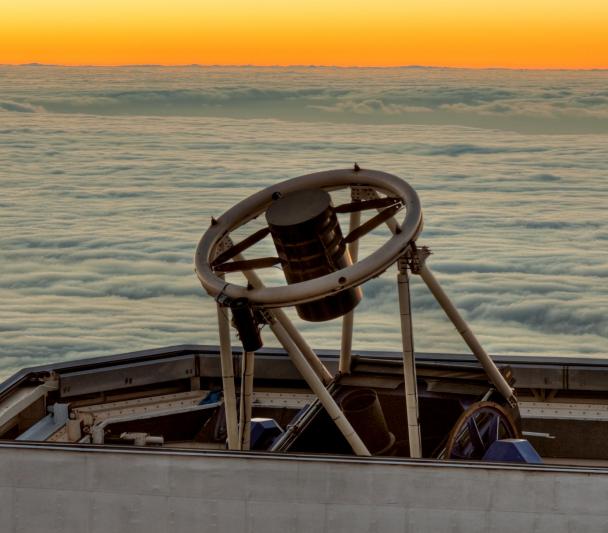
Instalaciones relacionadas
Proyectos relacionados
Pequeños Cuerpos del Sistema Solar
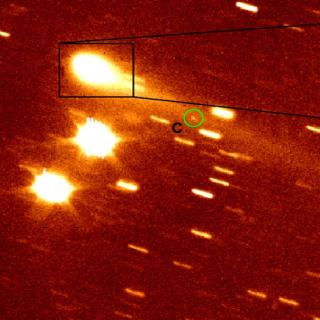
Este Proyecto estudia las propiedades físicas y composicionales de los llamados pequeños cuerpos del Sistema Solar, que incluyen asteroides, objetos helados y cometas. Entre los grupos de mayor interés destacan los objetos trans-neptunianos (TNOs), incluyendo los objetos más lejanos detectados hasta la fecha (Extreme-TNOs o ETNOs); los cometas, y
Julia de
León Cruz