
Bibcode
Cruz-Sanchez, N.; Fogantini, F. A.; Saavedra, E. A.; Abaroa, L.; García, F.; Combi, J. A.; Romero, G. E.
Referencia bibliográfica
Astronomy and Astrophysics
Fecha de publicación:
1
2025
Revista
Número de citas
5
Número de citas referidas
5
Descripción
We report the results obtained from the analysis of XMM-Newton and NuSTAR observations of two ultraluminous X-ray sources (ULXs) located in the galaxies ESO 501–023 and IC 5052. To better understand their nature, we studied the spectral and timing behavior of these sources. We used spectral-timing techniques to investigate the presence of possible pulsations in the data. We did not detect any significant pulsations and set upper limits on the pulsed fraction of < 9% for ESO 501–023 ULX and < 11% for IC 5052 X-1. These sources exhibit typical ULX X-ray spectra and can be well fitted with two thermal components plus a Comptonization tail at high energies. To classify the sources, we compared their spectral parameters with those of other well-known ULXs. Our results show that ESO 501–023 ULX is in the broadened disk state and IC 5052 X-1 is in the hard ultraluminous state. Finally, our results suggest that the sources are likely nonmagnetic, supercritically accreting objects fed by companion stars.
Proyectos relacionados
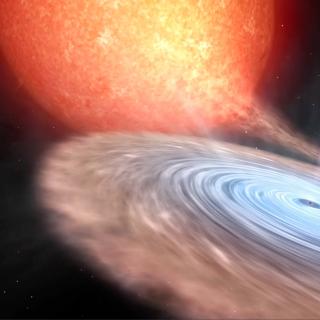
Agujeros negros, estrellas de neutrones, enanas blancas y su entorno local
Los agujeros negros y estrellas de neutrones en binarias de rayos-X son laboratorios únicos para explorar la física de estos objetos compactos. No solo permiten confirmar la existencia de agujeros negros de origen estelar a través de mediciones dinámicas de sus masas, sino que también permiten investigar el comportamiento de la materia y la
Montserrat
Armas Padilla