
Bibcode
Axelsson, M.; Ajello, M.; Arimoto, M.; Baldini, L.; Ballet, J.; Baring, M. G.; Bartolini, C.; Bastieri, D.; Becerra Gonzalez, J.; Bellazzini, R.; Berenji, B.; Bissaldi, E.; Blandford, R. D.; Bonino, R.; Bruel, P.; Buson, S.; Cameron, R. A.; Caputo, R.; Caraveo, P. A.; Cavazzuti, E.; Cheung, C. C.; Chiaro, G.; Cibrario, N.; Ciprini, S.; Cozzolongo, G.; Cristarella Orestano, P.; Crnogorcevic, M.; Cuoco, A.; Cutini, S.; D'Ammando, F.; De Gaetano, S.; Di Lalla, N.; Dinesh, A.; Di Tria, R.; Di Venere, L.; Domínguez, A.; Fegan, S. J.; Ferrara, E. C.; Fiori, A.; Franckowiak, A.; Fukazawa, Y.; Funk, S.; Fusco, P.; Galanti, G.; Gargano, F.; Gasbarra, C.; Germani, S.; Giacchino, F.; Giglietto, N.; Giliberti, M.; Gill, R.; Giordano, F.; Giroletti, M.; Granot, J.; Green, D.; Grenier, I. A.; Guiriec, S.; Gustafsson, M.; Hashizume, M.; Hays, E.; Hewitt, J. W.; Horan, D.; Kayanoki, T.; Kuss, M.; Laviron, A.; Li, J.; Liodakis, I.; Longo, F.; Loparco, F.; Lorusso, L.; Lott, B.; Lovellette, M. N.; Lubrano, P.; Maldera, S.; Malyshev, D.; Manfreda, A.; Martí-Devesa, G.; Martinelli, R.; Martinez Castellanos, I.; Mazziotta, M. N.; McEnery, J. E.; Mereu, I.; Meyer, M.; Michelson, P. F.; Mirabal, N.; Mitthumsiri, W.; Mizuno, T.; Monti-Guarnieri, P.; Monzani, M. E.; Morishita, T.; Morselli, A.; Moskalenko, I. V.; Negro, M.; Niwa, R.; Omodei, N.; Orienti, M.; Orlando, E.; Paneque, D.; Panzarini, G.; Persic, M. et al.
Referencia bibliográfica
The Astrophysical Journal Supplement Series
Fecha de publicación:
3
2025
Número de citas
32
Número de citas referidas
25
Descripción
We present a complete analysis of Fermi Large Area Telescope (LAT) data of GRB 221009A, the brightest gamma-ray burst (GRB) ever detected. The burst emission above 30 MeV detected by the LAT preceded, by 1 s, the low-energy (<10 MeV) pulse that triggered the Fermi Gamma-Ray Burst Monitor (GBM), as has been observed in other GRBs. The prompt phase of GRB 221009A lasted a few hundred seconds. It was so bright that we identify a bad time interval of 64 s caused by the extremely high flux of hard X-rays and soft gamma rays, during which the event reconstruction efficiency was poor and the dead time fraction quite high. The late-time emission decayed as a power law, but the extrapolation of the late-time emission during the first 450 s suggests that the afterglow started during the prompt emission. We also found that high-energy events observed by the LAT are incompatible with synchrotron origin, and, during the prompt emission, are more likely related to an extra component identified as synchrotron self-Compton (SSC). A remarkable 400 GeV photon, detected by the LAT 33 ks after the GBM trigger and directionally consistent with the location of GRB 221009A, is hard to explain as a product of SSC or TeV electromagnetic cascades, and the process responsible for its origin is uncertain. Because of its proximity and energetic nature, GRB 221009A is an extremely rare event.
Proyectos relacionados
Astrofísica de Partículas
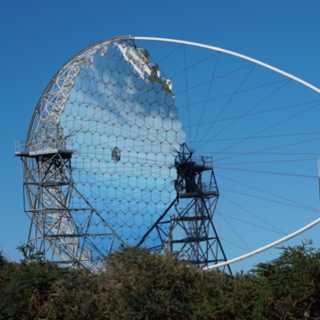
El Grupo de Astrofísica de Partículas del IAC participa activamente en tres grandes colaboraciones internacionales de astrofísica de muy altas energías: AMS-02 (Alpha Magnetic Spectrometer), los telescopios de radiación Cherenkov MAGIC I y II y el Cherenkov Telescope Array Observatory ( CTAO). Además, participamos en el ASTRI mini-array, el
Mónica Luisa
Vázquez Acosta