
Bibcode
Walker, A. R.; Kunder, A. M.; Andreuzzi, G.; di Cecco, A.; Stetson, P. B.; Monelli, M.; Cassisi, S.; Bono, G.; de Propris, R.; Dall'Ora, M.; Nemec, J. M.; Zoccali, M.
Referencia bibliográfica
Monthly Notices of the Royal Astronomical Society, Volume 415, Issue 1, pp. 643-654.
Fecha de publicación:
7
2011
Número de citas
30
Número de citas referidas
28
Descripción
We present new multiband photometry for the Galactic globular cluster IC
4499 extending well past the main-sequence turn-off in the U, B, V, R, I
and DDO 51 bands. This photometry is used to determine that IC 4499 has
an age of 12 ± 1 Gyr and a cluster reddening of E(B-V) = 0.22
± 0.02. Hence, IC 4499 is coeval with the majority of Galactic
globular clusters, in contrast to suggestions of a younger age. The
density profile of the cluster is observed to not flatten out to at
least r˜ 800 arcsec, implying that either the tidal radius of this
cluster is larger than previously estimated, or that IC 4499 is
surrounded by a halo. Unlike the situation in some other, more massive,
globular clusters, no anomalous colour spreads in the ultraviolet are
detected among the red giant branch stars. The small uncertainties in
our photometry should allow the detection of such signatures apparently
associated with variations of light elements within the cluster,
suggesting that IC 4499 consists of a single stellar population. Based
in part on observations made with the European Southern Observatory
telescopes obtained from the ESO/ST-ECF Science Archive Facility.
Proyectos relacionados
Vía Láctea y galaxias cercanas
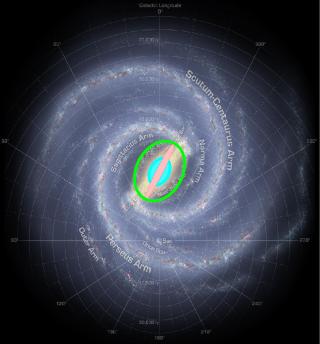
El objetivo general del proyecto es el estudio de la morfología, poblaciones estelares, cinemática y dinámica (incluyendo formación y evolución) de la Vía Láctea y sus galaxias satélites u otras del Grupo Local. El proyecto puede dividirse en dos líneas principales: I. Estructura de la Vía Láctea y galaxias cercanas. El estudio detallado de la
Martín
López Corredoira