
Bibcode
To, Chun-Hao; Krause, Elisabeth; Chang, Chihway; Wu, Hao-Yi; Wechsler, Risa H.; Rozo, Eduardo; Weinberg, David H.; Anbajagane, D.; Avila, S.; Blazek, J.; Bocquet, S.; Costanzi, M.; De Vicente, J.; Elvin-Poole, J.; Ferté, A.; Grandis, S.; Muir, J.; Porredon, A.; Samuroff, S.; Sanchez, E.; Cid, D. Sanchez; Sevilla-Noarbe, I.; Weaverdyck, N.; Abbott, T. M. C.; Aguena, M.; Andrade-Oliveira, F.; Bacon, D.; Becker, M. R.; Brooks, D.; Carnero Rosell, A.; Carretero, J.; Choi, A.; da Costa, L. N.; Pereira, M. E. S.; Davis, T. M.; Desai, S.; Doel, P.; Doux, C.; Everett, S.; Frieman, J.; García-Bellido, J.; Gatti, M.; Gaztanaga, E.; Giannini, G.; Gruen, D.; Gutierrez, G.; Hinton, S. R.; Hollowood, D. L.; Honscheid, K.; Jeltema, T.; Kuehn, K.; Lee, S.; Marshall, J. L.; Mena-Fernández, J.; Miquel, R.; Mohr, J. J.; Myles, J.; Palmese, A.; Malagón, A. A. Plazas; Romer, A. K.; Shin, T.; Smith, M.; Suchyta, E.; Tarle, G.; Vikram, V.; Walker, A. R.; Weller, J.; DES Collaboration
Referencia bibliográfica
Physical Review D
Fecha de publicación:
9
2025
Revista
Número de citas
13
Número de citas referidas
9
Descripción
We introduce an updated To&Krause2021 model for joint analyses of cluster abundances and large-scale two-point correlations of weak lensing and galaxy and cluster clustering (termed CL+3×2 pt analysis) and validate that this model meets the systematic accuracy requirements of analyses with the statistical precision of the final Dark Energy Survey (DES) Year 6 (Y6) dataset. The validation program consists of two distinct approaches, (i) identification of modeling and parametrization choices and impact studies using simulated analyses with each possible model misspecification and (ii) end-to-end validation using mock catalogs from customized Cardinal simulations that incorporate realistic galaxy populations and DES-Y6-specific galaxy and cluster selection and photometric redshift modeling, which are the key observational systematics. In combination, these validation tests indicate that the model presented here meets the accuracy requirements of DES-Y6 for CL+3×2 pt based on a large list of tests for known systematics. In addition, we also validate that the model is sufficient for several other data combinations: the CL+GC subset of this data vector (excluding galaxy–galaxy lensing and cosmic shear two-point statistics) and the CL+3×2 pt+BAO+SN (combination of CL+3×2 pt with the previously published Y6 DES baryonic acoustic oscillation and Y5 supernovae data).
Proyectos relacionados
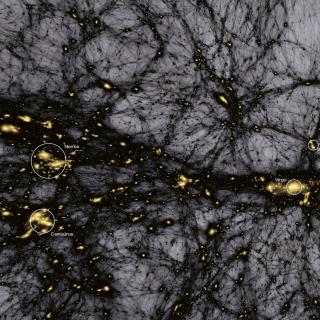
Cosmología con Trazadores de la Estructura a Gran Escala del Universo
El Fondo Cósmico de Microondas (FCM) contiene la información estadística de las semillas primigenias que han dado lugar a la formación de todas las estructuras en el Universo. Su contrapartida natural en el Universo local es la distribución de las galaxias que surgen como resultado del crecimiento gravitatorio de aquellas fluctuaciones de densidad
Francisco Shu
Kitaura Joyanes