
Bibcode
Burridge, Benjamin J.; Miller-Jones, James C. A.; Bahramian, Arash; Prabu, Steve R.; Streeter, Reagan; Castro Segura, Noel; Corral-Santana, Jesús M.; Knigge, Christian; Zdziarski, Andrzej; Mata Sánchez, Daniel; Tremou, Evangelia; Carotenuto, Francesco; Fender, Rob; Saikia, Payaswini
Referencia bibliográfica
The Astrophysical Journal
Fecha de publicación:
12
2025
Revista
Número de citas
21
Número de citas referidas
19
Descripción
We review the existing distance estimates to the black hole X-ray binary Swift J1727.8─1613, present new radio and near-UV spectra to update the distance constraints, and discuss the accuracies and caveats of the associated methodologies. We use line-of-sight H I absorption spectra captured using the MeerKAT radio telescope to estimate a maximum radial velocity with respect to the local standard of rest of 24.8 ± 2.8 km s−1 for Swift J1727.8−1613, which is significantly lower than that of a nearby extragalactic reference source. From this, we derive a near-kinematic distance of dnear = 3.6 ± 0.3 (stat) ± 2.3 (sys) kpc as a lower bound after accounting for additional uncertainties given its Galactic longitude and latitude, (l, b) ≍ (8.6°, 10.3°). Near-UV spectra from the Hubble Space Telescope's Space Telescope Imaging Spectrograph allows us to constrain the line-of-sight color excess to E(B ─ V) = 0.37 ± 0.01 (stat) ± 0.025 (sys). We then implement this in Monte Carlo simulations and present a distance to Swift J1727.8−1613 of 5.5−1.1+1.4 kpc, under the assumption that the donor star is an unevolved, main-sequence K4(±1)V star. This distance implies a natal kick velocity of 190 ± 30 km s−1 and therefore an asymmetrical supernova explosion within the Galactic disk as the expected birth mechanism. A lower distance is implied if the donor star has instead lost significant mass during the binary evolution. Hence, more accurate measurements of the binary inclination angle or donor star rotational broadening from future observations would help to better constrain the distance.
Proyectos relacionados
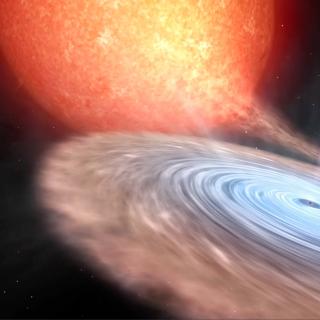
Agujeros negros, estrellas de neutrones, enanas blancas y su entorno local
Los agujeros negros y estrellas de neutrones en binarias de rayos-X son laboratorios únicos para explorar la física de estos objetos compactos. No solo permiten confirmar la existencia de agujeros negros de origen estelar a través de mediciones dinámicas de sus masas, sino que también permiten investigar el comportamiento de la materia y la
Montserrat
Armas Padilla