
Bibcode
Kitaura, Francisco-Shu; Kitaura, Emi-Pauline; Janssen, Niels; Maselli, Antonella; Pereda, Ernesto; Carnero Rosell, Aurelio
Referencia bibliográfica
Scientific Reports
Fecha de publicación:
11
2025
Número de citas
1
Número de citas referidas
1
Descripción
Sonification, the process of translating data into sound, has recently gained traction as a tool for both disseminating scientific findings and enabling visually impaired individuals to analyze data. Despite its potential, most current sonification methods remain limited to one-dimensional data, primarily due to the absence of practical, quantitative, and robust techniques for handling multi-dimensional datasets. We analyze structural magnetic resonance imaging (MRI) data of the human brain by integrating two- and three-point statistical measures in Fourier space: the power spectrum and bispectrum. These quantify the spatial correlations of three-dimensional voxel intensity distributions, yielding reduced bispectra that capture higher-order interactions. To illustrate the potential of the approach, we focus on one representative reduced-bispectrum configuration (Q019036) in the OASIS-3 dataset (864 imaging sessions) and provide audio renderings for five age groups (40─50, 50─60, 60─70, 70─80, 80─100 years). As context, prior work with this configuration reported an age-prediction MAE of $$\approx$$4.2 years based on neural networks, trained on bispectrum-derived features─not through sonification itself. But here we emphasize sonification rather than predictive benchmarking. Finally, we treat these audio examples as exploratory illustrations rather than a perceptual evaluation. Our results demonstrate that the information loss (e.g., normalized mean squared error) during the reconstruction of the original bispectra, specifically in configurations sensitive to brain aging, from the sonified signal is minimal. Future studies should include systematic statistical inference and perceptual validation to assess the robustness and perceptual utility of the method. Nevertheless, the approach presented here already provides a general framework for encoding multi-dimensional data into time-series-like arrays suitable for sonification, thereby opening new avenues for scientific exploration and improving accessibility for a broader audience.
Proyectos relacionados
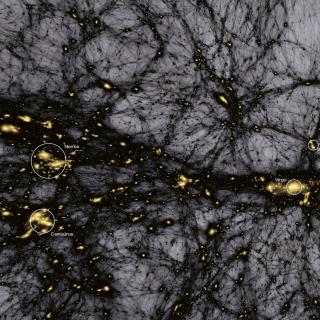
Cosmología con Trazadores de la Estructura a Gran Escala del Universo
El Fondo Cósmico de Microondas (FCM) contiene la información estadística de las semillas primigenias que han dado lugar a la formación de todas las estructuras en el Universo. Su contrapartida natural en el Universo local es la distribución de las galaxias que surgen como resultado del crecimiento gravitatorio de aquellas fluctuaciones de densidad
Francisco Shu
Kitaura Joyanes