
Bibcode
Piotto, G.; Milone, A. P.; Anderson, J.; Bedin, L. R.; Bellini, A.; Cassisi, S.; Marino, A. F.; Aparicio, A.; Nascimbeni, V.
Referencia bibliográfica
The Astrophysical Journal, Volume 760, Issue 1, article id. 39, 23pp, (2012).
Fecha de publicación:
11
2012
Revista
Número de citas
154
Número de citas referidas
134
Descripción
In the last few years many globular clusters (GCs) have revealed complex
color-magnitude diagrams, with the presence of multiple main sequences
(MSs), broad or multiple sub-giant branches (SGBs) and MS turnoffs, and
broad or split red giant branches (RGBs). After a careful correction for
differential reddening, high-accuracy photometry with the Hubble Space
Telescope (HST) presented in this paper reveals a broadened or even
split SGB in five additional Milky Way GCs: NGC 362, NGC 5286, NGC 6656,
NGC 6715, and NGC 7089. In addition, we confirm (with new and archival
HST data) the presence of a split SGB in 47 Tuc, NGC 1851, and NGC 6388.
The fraction of faint SGB stars with respect to the entire SGB
population varies from one cluster to another and ranges from ~0.03 for
NGC 362 to ~0.50 for NGC 6715. The average magnitude difference between
the bright SGB and the faint SGB is almost the same at different
wavelengths. This peculiarity is consistent with the presence of two
groups of stars with either an age difference of about 1-2 Gyr or a
significant difference in their overall C+N+O content.
Based on observations with the NASA/ESA Hubble Space Telescope, obtained
at the Space Telescope Science Institute, which is operated by AURA,
Inc., under NASA contract NAS 5-26555.
Proyectos relacionados
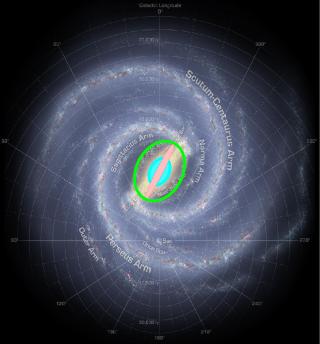
Vía Láctea y galaxias cercanas
El objetivo general del proyecto es el estudio de la morfología, poblaciones estelares, cinemática y dinámica (incluyendo formación y evolución) de la Vía Láctea y sus galaxias satélites u otras del Grupo Local. El proyecto puede dividirse en dos líneas principales: I. Estructura de la Vía Láctea y galaxias cercanas. El estudio detallado de la
Martín
López Corredoira