
Bibcode
Moura, Micheli T.; Ferré-Mateu, Anna; Chies-Santos, Ana L.; Furlanetto, Cristina; Beasley, Michael A.
Referencia bibliográfica
Astronomy and Astrophysics
Fecha de publicación:
12
2025
Revista
Número de citas
1
Número de citas referidas
1
Descripción
The properties of massive and compact early-type galaxies provide important constraints on early galaxy formation processes. Among these, massive relic galaxies, characterized by old stellar populations and minimal late-time accretion, are considered to be preserved compact galaxies from the high-z Universe. In this work, we investigate the properties of compact and massive galaxies (CMGs) using the TNG50 cosmological simulation, applying a uniform selection criterion that matches observational surveys at z = 0, z = 0.3, and z = 0.7. This approach provides a basis for direct comparisons with observed compact galaxies at each evaluated redshift. We classify CMGs according to their stellar mass assembly histories to investigate how compactness relates to dynamical properties and chemical enrichment across cosmic time. Our results show that simulated CMGs consistently follow the observed mass─size relation, with the number of compact galaxies increasing at higher redshifts; this number density follows the trend seen in observational data. In the dynamical context, while observations suggest that relic galaxies are outliers in the stellar mass─velocity dispersion plane, the simulated compacts show relatively uniform velocity dispersions across different accretion histories. Observed relics tend to be more metal-rich than other compact galaxies with extended star formation histories, deviating from the local mass─metallicity relation. In contrast, simulated compact galaxies are, overall, more metal-rich than the quiescent population, regardless of their accretion histories. We also find that the deviation of the simulated CMGs from the mass─metallicity relation decreases with increasing redshift. These findings suggest that the extreme characteristics of the CMGs in TNG50, particularly with regard to metal enrichment and dynamical properties, are less pronounced than those observed in real relic galaxies. However, the results offer a theoretical framework for assessing the properties of such extreme objects from different epochs, highlighting both alignment with and deviations between the models.
Proyectos relacionados
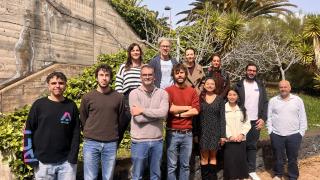
Huellas de la Formación de las Galaxias: Poblaciones estelares, Dinámica y Morfología
Bienvenida a la página web del g rupo de investigación Traces of Galaxy Formation. Somos un grupo de investigación amplio, diverso y muy activo cuyo objetivo principal es entender la formación de galaxias en el Universo de una manera lo más completa posible. Con el estudio detellado de las poblaciones estelares como bandera, estamos constantemente
Anna
Ferré Mateu