
Bibcode
Song, Donguk; Ishikawa, Ryohko; McKenzie, David E.; Trujillo Bueno, Javier; Auchère, Frédéric; Kano, Ryouhei; Winebarger, Amy; Okamoto, Takenori J.; Rachmeler, Laurel A.; Kobayashi, Ken; Vigil, Genevieve D.; Kobelski, Adam R.; Bethge, Christian; Lim, Eun-Kyung; Belluzzi, Luca; Alsina Ballester, Ernest; del Pino Alemán, Tanausú; Štěpán, Jiří
Referencia bibliográfica
SDO 2025 Science Workshop: A Gathering of the Helio-hive! Online at <A HREF="https://sdo2025.sdo-workshops.org/">https://sdo2025.sdo-workshops.org/<…
Fecha de publicación:
2
2025
Número de citas
0
Número de citas referidas
0
Descripción
We have developed an advanced ultraviolet (UV) spectropolarimeter called Chromospheric Layer SpectroPolarimeter (CLASP2), designed to explore the magnetic fields in the upper solar chromosphere. CLASP2 was launched on board a NASA sounding rocket experiment in 2019, and successfully detected the full Stokes vector in an active-region (AR) plage and in the quiet Sun near the limb across the Mg II h and k lines (280 nm) for the first time. After the experiment, CLASP2 was fully recovered and conducted a second experiment in 2021 under the new name CLASP2.1. During this experiment, we scanned the AR NOAA 12882 with a field of view of 28 arcseconds by 196 arcseconds. By analyzing the CLASP2.1 flight data, we have detected for the first time a magnetic discontinuity in the upper solar chromosphere associated with a coronal loop brightening. During 6-minutes flight of CLASP2.1, we find a coronal loop brightening that is intermittently and recurrently heated. The temperature of the brightening plasma is above 2.5 MK, which is higher than the ambient temperature, and no corresponding brightening is detected in the images of the photosphere and lower chromosphere. The notable finding of our study is that the coronal loop brightening of interest is observed along a region where the magnetic field polarity changes abruptly in the upper chromosphere. Our findings provide observational evidence that the heating mechanism of the coronal loop brightening is consistent with magnetic reconnection in the upper solar chromosphere.
Proyectos relacionados
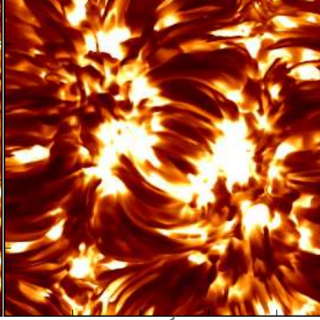
Magnetismo, Polarización y Transferencia Radiativa en Astrofísica
Los campos magnéticos están presentes en todos los plasmas astrofísicos y controlan la mayor parte de la variabilidad que se observa en el Universo a escalas temporales intermedias. Se encuentran en estrellas, a lo largo de todo el diagrama de Hertzsprung-Russell, en galaxias, e incluso quizás en el medio intergaláctico. La polarización de la luz
Ernest
Alsina Ballester
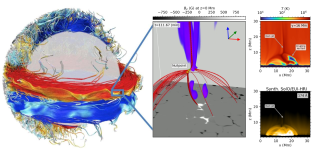
El proyecto Whole Sun: desentrañando los complejos mecanismos físicos detrás de nuestra estrella eruptiva y sus gemelos
El Sol es una estrella activa magnéticamente cuyas erupciones violentas pueden impactar y deformar la magnetosfera terrestre y causar perturbaciones importantes en instalaciones tecnológicas en tierra y en órbita. The Whole Sun tiene como objetivo central abordar, de forma coherente y por primera vez, cuestiones actuales clave en Física Solar
Fernando
Moreno Insertis