
Bibcode
Salabert, D.; García, R. A.; Jiménez, A.; Bertello, L.; Corsaro, E.; Pallé, P. L.
Referencia bibliográfica
Astronomy and Astrophysics, Volume 608, id.A87, 10 pp.
Fecha de publicación:
12
2017
Revista
Número de citas
42
Número de citas referidas
40
Descripción
We study the variability of solar activity using new photospheric
proxies originally developed for the analysis of stellar magnetism with
the CoRoT and Kepler photometric observations. These proxies were
obtained by tracking the temporal modulations in the observations
associated with the spots and magnetic features as the Sun rotates. We
analyzed 21 yr of observations, spanning solar cycles 23 and 24,
collected by the space-based photometric VIRGO and radial velocity GOLF
instruments on board the SoHO satellite. We then calculated the
photospheric activity proxy Sph is for each of the three
VIRGO photometers and the associated Svel proxy from the
radial velocity GOLF observations. Comparisons with several standard
solar activity proxies sensitive to different layers of the Sun
demonstrate that these new activity proxies, Sph and
Svel, provide a new manner to monitor solar activity. We show
that both the long- and short-term magnetic variabilities respectively
associated with the 11-yr cycle and the quasi-biennial oscillation are
well monitored, and that the magnetic field interaction between the
subsurface, photosphere, and chromosphere of the Sun was modified
between Cycle 24 and Cycle 23. Furthermore, the photometric proxies show
a wavelength dependence of the response function of the solar
photosphere among the three channels of the VIRGO photometers, providing
inputs for the study of the stellar magnetism of Sun-like stars.
Proyectos relacionados
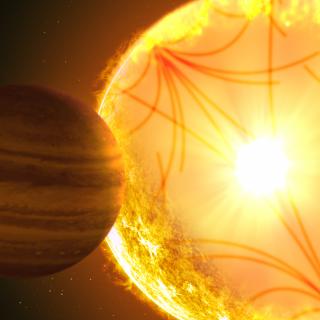
Sismología Solar y Estelar y Búsqueda de Exoplanetas
Los objetivos principales de este proyecto son: 1) estudiar la estructura y la dinámica del interior solar, 2) ampliar este estudio a otros tipos de estrellas y 3) buqueda de planetas extrasolares utilizando métodos fotométricos y su caracterización con información complementaria (espectrometría). Para alcanzar el primer objetivo, utilizamos la
Savita
Mathur