
Bibcode
Fridlund, M.; Hébrard, G.; Alonso, R.; Deleuil, M.; Gandolfi, D.; Gillon, M.; Bruntt, H.; Alapini, A.; Csizmadia, Sz.; Guillot, T.; Lammer, H.; Aigrain, S.; Almenara, J. M.; Auvergne, M.; Baglin, A.; Barge, P.; Bordé, P.; Bouchy, F.; Cabrera, J.; Carone, L.; Carpano, S.; Deeg, H. J.; de La Reza, R.; Dvorak, R.; Erikson, A.; Ferraz-Mello, S.; Guenther, E.; Gondoin, P.; den Hartog, R.; Hatzes, A.; Jorda, L.; Léger, A.; Llebaria, A.; Magain, P.; Mazeh, T.; Moutou, C.; Ollivier, M.; Pätzold, M.; Queloz, D.; Rauer, H.; Rouan, D.; Samuel, B.; Schneider, J.; Shporer, A.; Stecklum, B.; Tingley, B.; Weingrill, J.; Wuchterl, G.
Referencia bibliográfica
Astronomy and Astrophysics, Volume 512, id.A14
Fecha de publicación:
3
2010
Revista
Número de citas
55
Número de citas referidas
48
Descripción
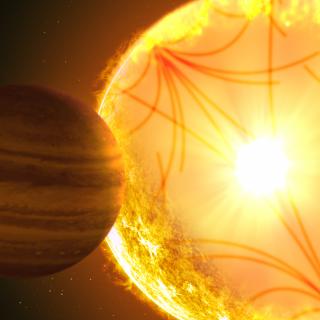
The CoRoT satellite exoplanetary team announces its sixth transiting
planet in this paper. We describe and discuss the satellite observations
as well as the complementary ground-based observations - photometric and
spectroscopic - carried out to assess the planetary nature of the object
and determine its specific physical parameters. The discovery reported
here is a “hot Jupiter” planet in an 8.9d orbit, 18 stellar
radii, or 0.08 AU, away from its primary star, which is a solar-type
star (F9V) with an estimated age of 3.0 Gyr. The planet mass is close to
3 times that of Jupiter. The star has a metallicity of 0.2 dex lower
than the Sun, and a relatively high 7Li abundance. While the
light curve indicates a much higher level of activity than, e.g., the
Sun, there is no sign of activity spectroscopically in e.g., the [Ca ii]
H&K lines.
The CoRoT space mission, launched on December 27, 2006, has been
developed and is being operated by CNES, with the contribution of
Austria, Belgium, Brazil, ESA, The Research and Scientific Support
Department of ESA, Germany and Spain.
Proyectos relacionados
Sismología Solar y Estelar y Búsqueda de Exoplanetas
Los objetivos principales de este proyecto son: 1) estudiar la estructura y la dinámica del interior solar, 2) ampliar este estudio a otros tipos de estrellas y 3) buqueda de planetas extrasolares utilizando métodos fotométricos y su caracterización con información complementaria (espectrometría). Para alcanzar el primer objetivo, utilizamos la
Savita
Mathur