
It may interest you
-
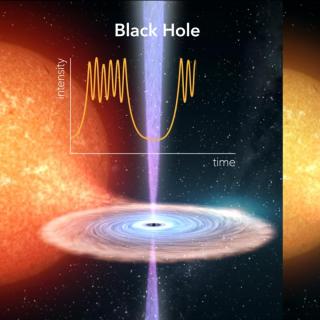 Accretion disks around compact objects are expected to enter an unstable phase at high luminosity. One instability may occur when the radiation pressure generated by accretion modifies the disk viscosity, resulting in the cyclic depletion and refilling of the inner disk on short timescales. Such a scenario, however, has only been quantitatively verified for a single stellar-mass black hole. Although there are hints of these cycles in a few isolated cases, their apparent absence in the variable emission of most bright accreting neutron stars and black holes has been a continuing puzzle. HereAdvertised on
 -
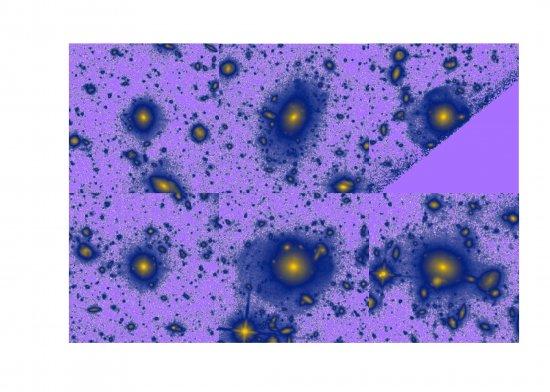
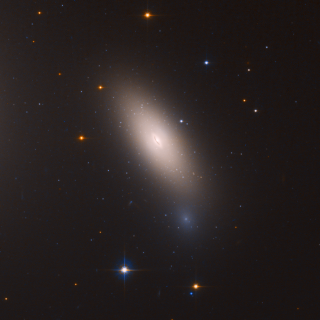 The standard cosmological model states that massive galaxies contain a large fraction of dark matter. Dark matter is a transparent substance that does not interact through regular baryonic matter and is only detected through its gravitational pull over the stars and the gas. NGC 1277 is known as the prototype of a relic galaxy, that is, a galaxy that has not accreted other galaxies since it formed. Relic galaxies are extremely rare and are the untouched remains of the giant galaxies that populated the early Universe. Since relic galaxies are very important to understand the conditions in theAdvertised on
 -
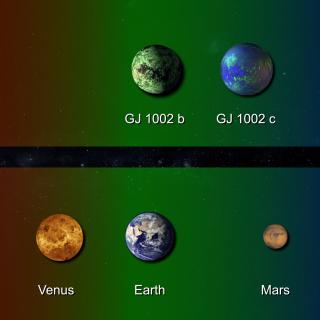 Red dwarfs are the most common stars in the galaxy. In recent years they have become key targets in the search for exoplanets. These stars are usually accompanied by rocky planets and due to their low brightness, their habitable zone is close to the star, making it easier to find planets that are within it. GJ 1002 is a red dwarf just one-eighth the mass of the Sun, located only 15.8 light-years away. Using radial velocity measurements from the ESPRESSO and CARMENES spectrographs, we have discovered the presence of two Earth-like and potentially habitable planets. The planets, GJ 1002 b andAdvertised on