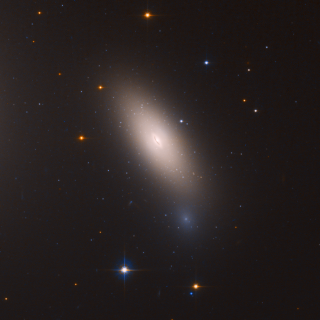
We have selected the Galactic HII region M43, a close-by apparently spherical nebula ionized by a single star (HD37061, B0.5V) to investigate several topics of recent interest in the field of HII regions and massive stars. We perform a combined, comprehensive study of the nebula and its ionizing star by using as many observational constraints as possible. For this study we collected a set of high-quality observations, including the optical spectrum of HD3706, along with nebular optical imaging and long-slit spatially resolved spectroscopy. On the one hand, we have carried out a quantitative spectroscopic analysis of the ionizing star from which we have determined the stellar parameters of HD37061 and the total number of ionizing photons emitted by the star; on the other hand, we have done a empirical analysis of the nebular images and spectroscopy from which we have find observational evidence of scattered light from the Huygens region (the brightest part of the Orion nebula) in the M43 region. We show the importance of an adequate correction of this scattered light in both the imagery and spectroscopic observations of M43 in accurately determining the total nebular Halpha luminosity, the nebular physical conditions. and chemical abundances. We have computed total abundances for three of the analyzed elements (O, S, and N), directly from observable ions (no ionization correction factors are needed). The comparison of these abundances with those derived from the spectrum of the Orion nebula indicates the importance of the atomic data and, specially in the case of M42, the considered ionization correction factors.
Advertised on
It may interest you
-
In the standard cosmological model (𝜦CDM), galaxies are merely the visible "tips of the icebergs," residing within massive, invisible cocoons of dark matter known as haloes. While these haloes dictate the evolution and motion of galaxies, measuring their true size and mass has long been one of the most challenging tasks in astrophysics. A new study published in Astronomy & Astrophysics by Claudio Dalla Vecchia and Ignacio Trujillo from the Instituto de Astrofísica de Canarias (IAC) proposes a breakthrough: a physically motivated definition of a galaxy’s edge that acts as a precision "ruler"Advertised on -
The rocky planet GJ 1132 b, with Earth-like mass and radius, is a prime candidate for atmospheric studies. Previous observations with Hubble and JWST yielded conflicting results about its atmosphere. This study used three transit observations with the CRIRES+ instrument to search for He i, HCN, CH₄, and H₂O in GJ 1132 b's atmosphere. No clear atmospheric signals were detected, but upper limits for CH₄, HCN, and H₂O were established. The results suggest that if GJ 1132 b has an atmosphere, it is not dominated by hydrogen. The work highlights the challenges of detecting high molecular weightAdvertised on -
The solar corona—the outermost layer of the Sun’s atmosphere—is extremely hot and very low in density. One of the main challenges in solar physics is understanding why the corona reaches temperatures of over a million degrees. This heating is believed to be closely related to the Sun’s magnetic field. However, quantifying the coronal magnetic field is difficult because the light emitted by the corona is extremely faint, and its polarization signals, which encode the information on the magnetic field, are subtle. Thanks to recent advances in technology, telescopes like the Daniel K. InouyeAdvertised on