
Bibcode
Smith, A. M. S.; Csizmadia, Sz.; Van Grootel, V.; Lendl, M.; Persson, C. M.; Olofsson, G.; Ehrenreich, D.; Günther, M. N.; Heitzmann, A.; Barros, S. C. C.; Bonfanti, A.; Brandeker, A.; Cabrera, J.; Demangeon, O. D. S.; Fossati, L.; Harre, J. -V.; Hooton, M. J.; Hoyer, S.; Kalman, Sz.; Salmon, S.; Sousa, S. G.; Szabó, Gy. M.; Wilson, T. G.; Alibert, Y.; Alonso, R.; Asquier, J.; Bárczy, T.; Barrado, D.; Baumjohann, W.; Benz, W.; Billot, N.; Borsato, L.; Broeg, C.; Collier Cameron, A.; Correia, A. C. M.; Cubillos, P. E.; Davies, M. B.; Deleuil, M.; Deline, A.; Demory, B. -O.; Derekas, A.; Edwards, B.; Egger, J. A.; Erikson, A.; Fortier, A.; Fridlund, M.; Gandolfi, D.; Gazeas, K.; Gillon, M.; Güdel, M.; Hasiba, J.; Helling, Ch.; Isaak, K. G.; Kiss, L. L.; Korth, J.; Lam, K. W. F.; Laskar, J.; Lecavelier des Etangs, A.; Magrin, D.; Maxted, P. F. L.; Merín, B.; Mordasini, C.; Nascimbeni, V.; Ottensamer, R.; Pagano, I.; Pallé, E.; Peter, G.; Piazza, D.; Piotto, G.; Pollacco, D.; Queloz, D.; Ragazzoni, R.; Rando, N.; Rauer, H.; Ribas, I.; Santos, N. C.; Scandariato, G.; Ségransan, D.; Simon, A. E.; Stalport, M.; Sulis, S.; Udry, S.; Ulmer-Moll, S.; Venturini, J.; Villaver, E.; Viotto, V.; Walter, I.; Walton, N. A.; Wolf, S.
Referencia bibliográfica
Astronomy and Astrophysics
Fecha de publicación:
1
2025
Revista
Número de citas
3
Número de citas referidas
3
Descripción
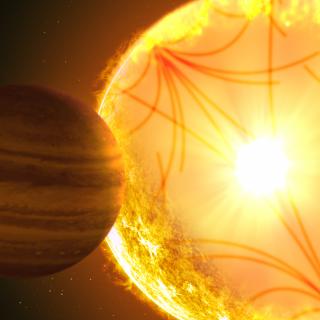
Aims. We aim to observe the transits and occultations of WASP-33 b, which orbits a rapidly rotating δ Scuti pulsator, with the goal of measuring the orbital obliquity via the gravity-darkening effect, and constraining the geometric albedo via the occultation depth. Methods. We observed four transits and four occultations with CHEOPS, and employ a variety of techniques to remove the effects of the stellar pulsations from the light curves, as well as the usual CHEOPS systematic effects. We also performed a comprehensive analysis of low-resolution spectral and Gaia data to re-determine the stellar properties of WASP-33. Results. We measure an orbital obliquity 111.3‑0.7+0.2 degrees, which is consistent with previous measurements made via Doppler tomography. We also measure the planetary impact parameter, and confirm that this parameter is undergoing rapid secular evolution as a result of nodal precession of the planetary orbit. This precession allows us to determine the second-order fluid Love number of the star, which we find agrees well with the predictions of theoretical stellar models. We are unable to robustly measure a unique value of the occultation depth, and emphasise the need for long-baseline observations to better measure the pulsation periods.
Proyectos relacionados

Exoplanetas y Astrobiología
La búsqueda de vida en el Universo se ha visto impulsada por los recientes descubrimientos de planetas alrededor de otras estrellas (los llamados exoplanetas), convirtiéndose en uno de los campos más activos dentro de la Astrofísica moderna. En los últimos años los descubrimientos cada vez más numerosos de nuevos exoplanetas y los últimos avances
Enric
Pallé Bago
Sismología Solar y Estelar y Búsqueda de Exoplanetas
Los objetivos principales de este proyecto son: 1) estudiar la estructura y la dinámica del interior solar, 2) ampliar este estudio a otros tipos de estrellas y 3) buqueda de planetas extrasolares utilizando métodos fotométricos y su caracterización con información complementaria (espectrometría). Para alcanzar el primer objetivo, utilizamos la
Savita
Mathur