
Bibcode
Hareter, M.; Fossati, L.; Weiss, W.; Suárez, J. C.; Uytterhoeven, K.; Rainer, M.; Poretti, E.
Referencia bibliográfica
The Astrophysical Journal, Volume 743, Issue 2, article id. 153 (2011).
Fecha de publicación:
12
2011
Revista
Número de citas
16
Número de citas referidas
14
Descripción
δ Sct-γ Dor hybrids pulsate simultaneously in p- and
g-modes, which carry information on the structure of the envelope as
well as to the core. Hence, they are key objects for investigating A and
F type stars with asteroseismic techniques. An important requirement for
seismic modeling is small errors in temperature, gravity, and chemical
composition. Furthermore, we want to investigate the existence of an
abundance indicator typical for hybrids, something that is well
established for the roAp stars. Previous to the present investigation,
the abundance pattern of only one hybrid and another hybrid candidate
has been published. We obtained high-resolution spectra of HD 114839 and
BD +18 4914 using the SOPHIE spectrograph of the Observatoire de
Haute-Provence and the HARPS spectrograph at ESO La Silla. For each star
we determined fundamental parameters and photospheric abundances of 16
chemical elements by comparing synthetic spectra with the observations.
We compare our results to that of seven δ Sct and nine γ Dor
stars. For the evolved BD +18 4914 we found an abundance pattern typical
for an Am star, but could not confirm this peculiarity for the less
evolved star HD 114839, which is classified in the literature as
uncertain Am star. Our result supports the concept of evolved Am stars
being unstable. With our investigation we nearly doubled the number of
spectroscopically analyzed δ Sct-γ Dor hybrid stars, but did
not yet succeed in identifying a spectroscopic signature for this group
of pulsating stars. A statistically significant spectroscopic
investigation of δ Sct- γ Dor hybrid stars is still missing,
but would be rewarding considering the asteroseismological potential of
this group.
Based on observations made at the Observatoire de Haute-Provence and
with HARPS at the 3.6 m ESO telescope under the Large Programme
LP185.D-0056.
Proyectos relacionados
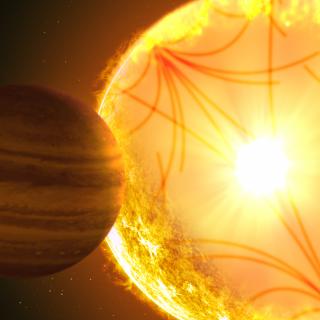
Sismología Solar y Estelar y Búsqueda de Exoplanetas
Los objetivos principales de este proyecto son: 1) estudiar la estructura y la dinámica del interior solar, 2) ampliar este estudio a otros tipos de estrellas y 3) buqueda de planetas extrasolares utilizando métodos fotométricos y su caracterización con información complementaria (espectrometría). Para alcanzar el primer objetivo, utilizamos la
Savita
Mathur