
Bibcode
Zeuner, Franziska; Alsina Ballester, Ernest; Belluzzi, Luca; Casini, Roberto; Harrington, David M.; del Pino Alemán, Tanausú; Trujillo Bueno, Javier
Referencia bibliográfica
Astronomy and Astrophysics
Fecha de publicación:
4
2026
Revista
Número de citas
0
Número de citas referidas
0
Descripción
Context. Scattering polarization signals in the Sr I 4607 Å spectral line are among the strongest originating from the solar photosphere, and they offer a powerful diagnostic of tangled magnetic fields in the 3─300 G range via the Hanle effect. However, measuring them with sub-arcsecond resolution remains a significant challenge, because their detection demands exceptionally precise and accurate observational techniques. Aims. We analyze spatially resolved quiet Sun observations of these signals performed with the Visible Spectropolarimeter (ViSP) at the Daniel K. Inouye Solar Telescope (DKIST) to identify its current observational limits. Methods. We present high-resolution, high-precision spectropolarimetric observations in a spectral window including the Sr I 4607 Å line at various limb distances. We applied consistent instrumental corrections across all spectral lines, enabling the adjacent lines to serve as reliable references. Results. Close to the limb, the signal-to-noise is high, and we confirm that the center-to-limb variation of scattering polarization is compatible with previous studies. At a limb distance of μ = 0.74, the signal-to-noise is low but sufficient in the total linear polarization map to directly reveal sub-arcsecond structures in the Sr I line for the first time, which can be attributed to scattering polarization. Disk-center measurements are still dominated by the noise related to the current limitations of the observational setup. Conclusions. By combining high spatio-temporal and spectral resolution with exceptional polarimetric precision, DKIST enables measurements of solar photospheric scattering polarization at fine scales. These advances open new possibilities for using scattering polarization as a diagnostic tool for detecting tangled magnetic fields at small spatial scales, offering deeper insights into the solar small-scale dynamo. However, current signal-to-noise limitations still hinder direct detection of disk-center scattering polarization and must be addressed before further progress can be made.
Proyectos relacionados
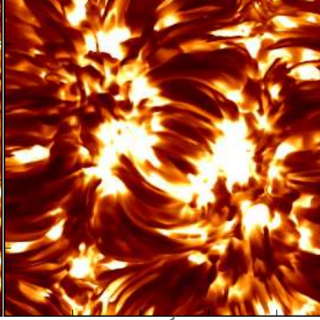
Magnetismo, Polarización y Transferencia Radiativa en Astrofísica
Los campos magnéticos están presentes en todos los plasmas astrofísicos y controlan la mayor parte de la variabilidad que se observa en el Universo a escalas temporales intermedias. Se encuentran en estrellas, a lo largo de todo el diagrama de Hertzsprung-Russell, en galaxias, e incluso quizás en el medio intergaláctico. La polarización de la luz
Ernest
Alsina Ballester
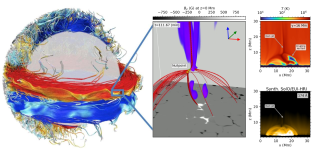
El proyecto Whole Sun: desentrañando los complejos mecanismos físicos detrás de nuestra estrella eruptiva y sus gemelos
El Sol es una estrella activa magnéticamente cuyas erupciones violentas pueden impactar y deformar la magnetosfera terrestre y causar perturbaciones importantes en instalaciones tecnológicas en tierra y en órbita. The Whole Sun tiene como objetivo central abordar, de forma coherente y por primera vez, cuestiones actuales clave en Física Solar
Fernando
Moreno Insertis