
Gas Molecular y Polvo en Galacias através del Tiempo Cósmico

Año de inicio
2015
Unidad organizativa

Subvenciones relacionadas:

    General
    Descripción

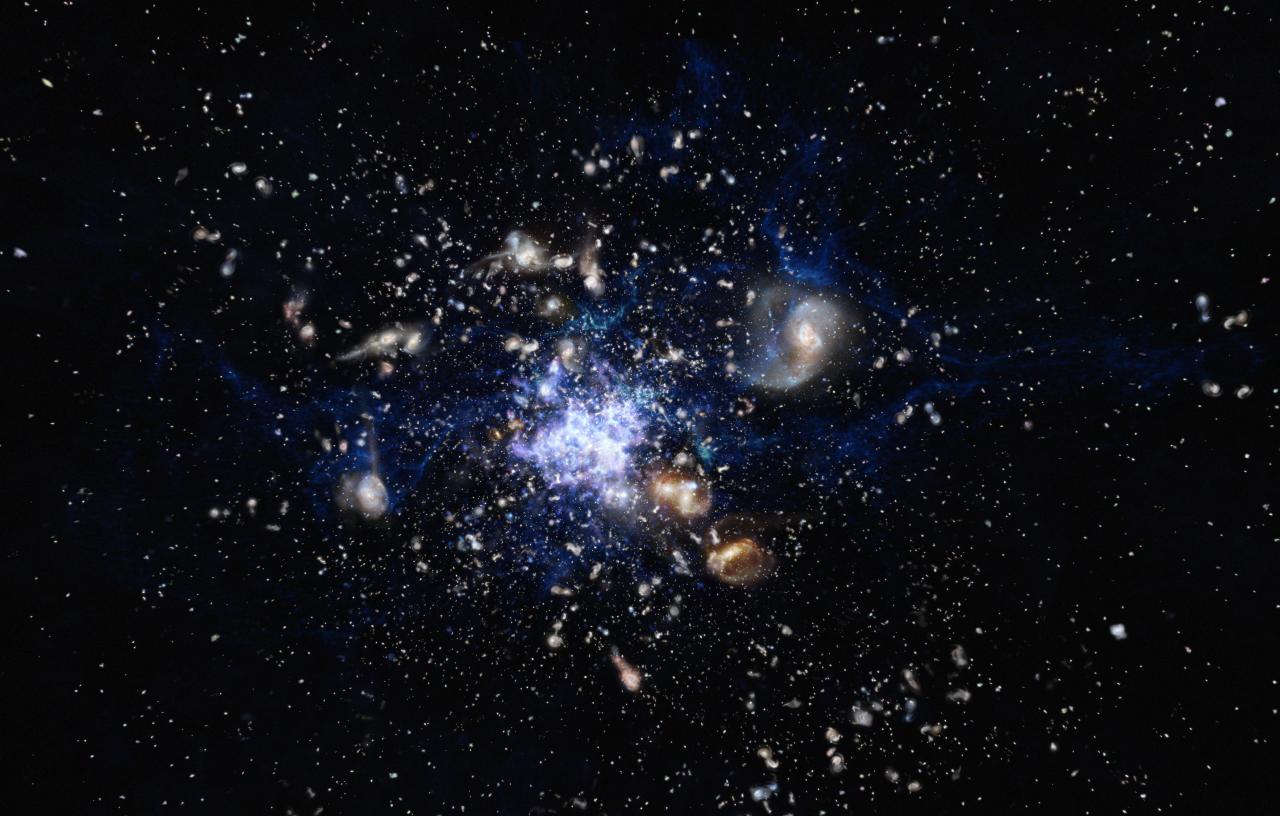
    Dos cuestiones fundamentales en la Astrofísica son la conversión de gas molecuar en estrellas y cómo este proceso físico depende del entorno en todas las escalas, desde sistemas planetarios, cúmulos estelares, galaxias hasta cúmulos de galaxias. El objectivo principal de este proyecto es el de estudiar la formación y evolución de galaxias a partir de la materia interstellar. Por ello, estudiaremos el gas molecuar frío, el combustible de la formación estelar y el polvo, producto residual del proceso de formación, en galaxias a través del tiempo cósmico. Los estudios están basados, sobre todo, en observaciones en el infrarrojo lejano y en el radio. Nos centraremos en observaciones con interferómetros de radio como son NOEMA, ALMA, ATCA, SMA y VLA. Se preveen estrechas colaboraciones con otros proyectos del IAC, sobre todo para observaciones de galaxias con telescopios de radio. El grupo de trabajo caracterizará las propiedades de la formación estelar de galaxias masivas en el universo lejano a través del tiempo cósmico. Esto nos dará la oportunidad de estudiar la secuencia de formación de galaxias con brote estelar. Además, este grupo de trabajo investigará fuentes selecionadas desde cúmulos de galaxias y del campo para explorar la evolución de galaxias en funcion del entorno. Además, realizaremos estudios complementarios de galaxias locales (seleccionadas desde CALIFA y WEAVE-APERTIF) que servirán de referencia para investigaciones futuras de galaxias a alto redshift.

    Investigador principal
    Personal del proyecto
    1. Observaciones de follow-up de una galaxia amplificada con brote estelar a z=2.04 con el radio interferómetro IRAM NOEMA descubrío propiedades del gas molecular extraordinaras y revelo la emision más alta en gas molecuar jamas visto en el universo distante; Dannerbauer et al. 2019, AJ, in prensa (astro-ph/1812.03845).
    2. Contribuciones con varios articulos de co-autor (parte de colaboraciones internacionales) a la investigacion de cúmulos de galaxias en formacion en el universo lejano y sus miembros via estudios de multi-longitud de ondas.
    3. Otorgada ayuda externa via el plan naciónal de MINECO para 2018 y 2019 incluyendo fondos para contrarar un postdoc por dos años (AYA2017-84061-P: ´De las primeras sobre-densidades a los proto-cumulos ycúmulos: el papel del entorno´, 141.570 Euro, IP1: H. Dannerbauer, IP2: J. M. Rodríguez-Espinosa).
    4. Concedido tiempo de observaciones para continuar y finalizar el ATCA programa larga 'COALAS: CO ATCA Legacy Archive of Star-Forming Galaxies' (IP: Helmut Dannerbauer), en total 640 horas (~500.000 Euro). Concedido el IRAM NOEMA programa larga ‘A Comprehensive NOEMA Redshift Survey of the Brightest Herschel Galaxies’ (CoIP: Dannerbauer) of 191 hrs. (~770.000 Euro).
    5. Organización del mini-symposium 'Build-Up of Galaxy Clusters' durante la IAU XXX Assamblea General en Viena en Agosto de 2018 y del splinter "Collaborative GTC-LMT projects" durante el GTC congreso en Valencia en Diciembre de 2018.
    Publicaciones relacionadas

    The WaZP galaxy cluster sample of the dark energy survey year 1 2021MNRAS.502.4435A
    CO Excitation, Molecular Gas Density, and Interstellar Radiation Field in Local and High-redshift Galaxies 2021ApJ...909...56L
    The interstellar medium of quiescent galaxies and its evolution with time 2021A&A...647A..33M
    Probing the existence of a rich galaxy overdensity at z = 5.2 2021MNRAS.502.4558C
    Close-up view of a luminous star-forming galaxy at z = 2.95 2021A&A...646A.122B
    Turbulent Gas in Lensed Planck-selected Starbursts at z ∼ 1-3.5 2021ApJ...908...95H
    Cosmological constraints from DES Y1 cluster abundances and SPT multiwavelength data 2021PhRvD.103d3522C
    DES Y1 results: Splitting growth and geometry to test Λ CDM 2021PhRvD.103b3528M
    A machine learning approach to galaxy properties: joint redshift-stellar mass probability distributions with Random Forest 2021MNRAS.502.2770M
    Evolution of galaxy scaling relations in clusters at 0.5 < z < 1.5 2021A&A...646A..53P
    Dark Energy Survey Year 3 results: Optimizing the lens sample in a combined galaxy clustering and galaxy-galaxy lensing analysis 2021PhRvD.103d3503P
    Shadows in the Dark: Low-surface-brightness Galaxies Discovered in the Dark Energy Survey 2021ApJS..252...18T
    The effect of environment on Type Ia supernovae in the Dark Energy Survey three-year cosmological sample 2021MNRAS.501.4861K
    Dark Energy Survey Year 1 results: the lensing imprint of cosmic voids on the cosmic microwave background 2021MNRAS.500..464V
    An ALMA/NOEMA survey of the molecular gas properties of high-redshift star-forming galaxies 2021MNRAS.501.3926B
    Compact, bulge-dominated structures of spectroscopically confirmed quiescent galaxies at z ≍ 3 2021MNRAS.501.2659L
    Machine Learning for Searching the Dark Energy Survey for Trans-Neptunian Objects 2021PASP..133a4501H
    Dark Energy Survey year 3 results: point spread function modelling 2021MNRAS.501.1282J
    Tracing the evolution of dust-obscured activity using sub-millimetre galaxy populations from STUDIES and AS2UDS 2021MNRAS.500..942D
    The EDGE-CALIFA survey: exploring the role of molecular gas on galaxy star formation quenching 2020A&A...644A..97C
    Perturbation theory for modeling galaxy bias: Validation with simulations of the Dark Energy Survey 2020PhRvD.102l3522P
    Tracing the evolution of dust-obscured activity using sub-millimetre galaxy populations from STUDIES and AS2UDS 2020MNRAS.500..942D
    First Cosmology Results using Supernovae Ia from the Dark Energy Survey: Survey Overview, Performance, and Supernova Spectroscopy 2020AJ....160..267S
    A DESGW Search for the Electromagnetic Counterpart to the LIGO/Virgo Gravitational-wave Binary Neutron Star Merger Candidate S190510g 2020ApJ...903...75G
    Observations of [OI]63-=μm line emission in main-sequence galaxies at z ∼ 1.5 2020MNRAS.499.1788W
    μ<SUB>⋆</SUB> masses: weak-lensing calibration of the Dark Energy Survey Year 1 redMaPPer clusters using stellar masses 2020MNRAS.498.5450P
    CO emission in distant galaxies on and above the main sequence 2020A&A...641A.155V
    Dust Reverberation Mapping in Distant Quasars from Optical and Mid-infrared Imaging Surveys 2020ApJ...900...58Y
    Noise from undetected sources in Dark Energy Survey images 2020MNRAS.497.2529E
    Emergence of an Ultrared, Ultramassive Galaxy Cluster Core at z = 4 2020ApJ...898..133L
    IRAM 30-m-EMIR redshift search of z = 3─4 lensed dusty starbursts selected from the HerBS sample 2020MNRAS.496.2372B
    Understanding galaxy formation and evolution through an all-sky submillimetre spectroscopic survey 2020PASA...37...25N
    COLDz: A High Space Density of Massive Dusty Starburst Galaxies ∼1 Billion Years after the Big Bang 2020ApJ...895...81R
    SCUBA-2 overdensities associated with candidate protoclusters selected from Planck data 2020MNRAS.494.5985C
    The Typical Massive Quiescent Galaxy at z ∼ 3 is a Post-starburst 2020ApJ...892L...2D
    Extended Hα over compact far-infrared continuum in dusty submillimeter galaxies. Insights into dust distributions and star-formation rates at z ∼ 2 2020A&A...635A.119C
    NOEMA redshift measurements of bright Herschel galaxies 2020A&A...635A...7N
    The Properties of the Interstellar Medium of Galaxies across Time as Traced by the Neutral Atomic Carbon [C i] 2020ApJ...890...24V
    SCUBA-2 Ultra Deep Imaging EAO Survey (Studies). III. Multiwavelength Properties, Luminosity Functions, and Preliminary Source Catalog of 450 μm Selected Galaxies 2020ApJ...889...80L
    On the Gas Content, Star Formation Efficiency, and Environmental Quenching of Massive Galaxies in Protoclusters at z ≈ 2.0─2.5 2019ApJ...887..183Z