
Bibcode
Creevey, O. L.; Uytterhoeven, K.; Martín-Ruiz, S.; Amado, P. J.; Niemczura, E.; van Winckel, H.; Suárez, J. C.; Rolland, A.; Rodler, F.; Rodríguez-López, C.; Rodríguez, E.; Raskin, G.; Rainer, M.; Poretti, E.; Pallé, P.; Molina, R.; Moya, A.; Mathias, P.; Le Guillou, L.; Hadrava, P.; Fabbian, D.; Garrido, R.; Decin, L.; Cutispoto, G.; Casanova, V.; Broeders, E.; Arellano Ferro, A.; Aceituno, F.
Referencia bibliográfica
Astronomy and Astrophysics, Volume 507, Issue 2, 2009, pp.901-910
Fecha de publicación:
11
2009
Revista
Número de citas
14
Número de citas referidas
10
Descripción
HD 172189 is a spectroscopic eclipsing binary system with a
rapidly-rotating pulsating δ Scuti component. It is also a member
of the open cluster IC 4756. These combined characteristics make it an
excellent laboratory for asteroseismic studies. To date, HD 172189 has
been analysed in detail photometrically but not spectroscopically. For
this reason we have compiled a set of spectroscopic data to determine
the absolute and atmospheric parameters of the components. We determined
the radial velocities (RV) of both components using four different
techniques. We disentangled the binary spectra using KOREL, and
performed the first abundance analysis on both disentangled spectra. By
combining the spectroscopic results and the photometric data, we
obtained the component masses, 1.8 and 1.7 M&sun;, and radii,
4.0 and 2.4 R&sun;, for inclination i = 73.2°,
eccentricity e = 0.28, and orbital period Π = 5.70198 days. Effective
temperatures of 7600 K and 8100 K were also determined. The measured v
sin i are 78 and 74 km s-1, respectively, giving rotational
periods of 2.50 and 1.55 days for the components. The abundance analysis
shows [Fe/H] = -0.28 for the primary (pulsating) star, consistent with
observations of IC 4756. We also present an assessment of the different
analysis techniques used to obtain the RVs and the global parameters.
Proyectos relacionados
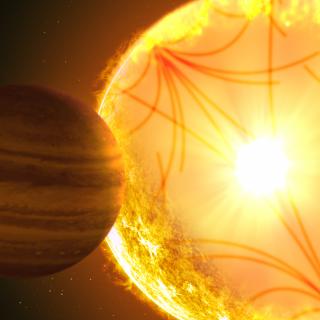
Sismología Solar y Estelar y Búsqueda de Exoplanetas
Los objetivos principales de este proyecto son: 1) estudiar la estructura y la dinámica del interior solar, 2) ampliar este estudio a otros tipos de estrellas y 3) buqueda de planetas extrasolares utilizando métodos fotométricos y su caracterización con información complementaria (espectrometría). Para alcanzar el primer objetivo, utilizamos la
Savita
Mathur