
Bibcode
Angeloudi, Eirini; Huertas-Company, Marc; Falcón-Barroso, Jesús; Perreault-Levasseur, Laurence; Adam, Alexandre; Boecker, Alina
Referencia bibliográfica
Astronomy and Astrophysics
Fecha de publicación:
11
2025
Revista
Número de citas
5
Número de citas referidas
3
Descripción
Context. Understanding the origin of stars within a galaxy, namely whether they formed in situ or were accreted from other galaxies (ex situ), is key to constraining its evolution. When they are spatially resolved, these components provide crucial insights into the mass assembly history of a galaxy. Aims. We predict the spatial distribution of the ex situ stellar mass fraction in MaNGA galaxies and identify distinct assembly histories based on the radial gradients of these predictions in the central regions. Methods. We employed a diffusion model trained on mock MaNGA analogs (MaNGIA) that were derived from the cosmological simulation TNG50. The model learned to predict the posterior distribution of resolved ex situ stellar mass fraction maps that were conditioned on the stellar mass density, the velocity, and the velocity dispersion gradient maps. After validating the model on an unseen test set from MaNGIA, we applied it to MaNGA galaxies to infer the spatially resolved distribution of their ex situ stellar mass fractions, that is, on the fraction of stellar mass in each spaxel originating from mergers. Results. We identified four broad categories of ex situ mass distributions: (1) flat gradient, in situ dominated; (2) flat gradient, ex situ dominated; (3) positive gradient; and (4) negative gradient. The vast majority of MaNGA galaxies fall in the first category. They have flat gradients with low ex situ fractions. This confirms that in situ star formation is the main assembly driver for low- to intermediate-mass galaxies. At high stellar masses ( > 1011 M⊙), the ex situ maps are more diverse. This highlights the key role of mergers in building the most massive systems. Ex situ mass distributions correlate with the morphology, the star formation activity, the stellar kinematics, and the environment. This indicates that the accretion history is a primary factor in shaping massive galaxies. Finally, by tracing their assembly histories in TNG50, we linked each class to distinct merger scenarios that ranged from secular evolution to merger-dominated growth. Conclusions. The central gradients of the ex situ stellar mass fraction encode meaningful information about the assembly history of galaxies. Our results highlight the power of combining cosmological simulations with machine-learning to infer the unseen components of galaxies from observable properties.
Proyectos relacionados
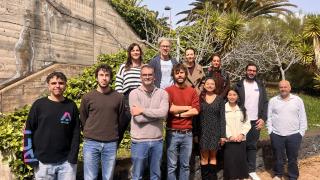
Huellas de la Formación de las Galaxias: Poblaciones estelares, Dinámica y Morfología
Bienvenida a la página web del g rupo de investigación Traces of Galaxy Formation. Somos un grupo de investigación amplio, diverso y muy activo cuyo objetivo principal es entender la formación de galaxias en el Universo de una manera lo más completa posible. Con el estudio detellado de las poblaciones estelares como bandera, estamos constantemente
Anna
Ferré Mateu