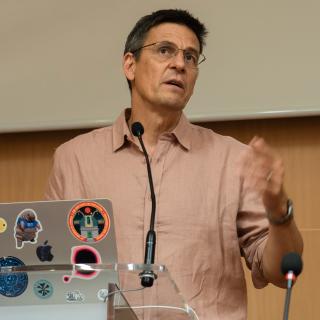

The smallest galaxies in the cosmos are emerging as one of the greatest challenges for modern astrophysics. A team of researchers from the Universidad de La Laguna and the Instituto de Astrofísica de Canarias (IAC) is studying these tiny systems to understand why they do not always match the predictions of the standard cosmological model.
The work is carried out within the framework of the INGENIO project, funded by the Agencia Estatal de Investigación (AEI), which uses advanced cosmological simulations to reconstruct the galactic environment closest to the Milky Way and explore physical processes that are still not fully understood.
Far from being secondary structures, dwarf galaxies—the most abundant in the Universe and highly dominated by dark matter—are revealing that some key mechanisms in galaxy formation may not yet be fully incorporated into current models.
A cosmic laboratory in our galactic neighbourhood
The research, led by theoretical astrophysicist Arianna Di Cintio, a researcher at the Universidad de La Laguna and the Instituto de Astrofísica de Canarias (IAC), focuses on the so-called Local Group of galaxies, the environment closest to the Milky Way.
Through high-resolution simulations, the team recreates a scenario that closely resembles the real Universe thanks to the use of constrained initial conditions. This approach allows for a direct comparison between theoretical results and astronomical observations. “We are not aiming to simulate a generic universe, but one that faithfully reflects our own environment,” explains the researcher.
This approach addresses a fundamental question: if the cosmological model accurately describes large-scale structures but shows systematic deviations in smaller systems, such as dwarf galaxies, it is likely that some key physical processes are still missing from our understanding.
The unexpected role of black holes
One of the most innovative aspects of the project is the analysis of the impact of black holes in very low-mass galaxies.
Traditionally, these systems were not expected to host active galactic nuclei (AGN), due to their small size. However, simulations developed by the IAC team point to a different scenario: even in isolated dwarf galaxies, central black holes can significantly influence their evolution.
This effect complements stellar feedback, and together they represent the two main mechanisms studied in the project to explain how star formation and galaxy growth are regulated.
Addressing discrepancies in the cosmological model
The INGENIO project tackles some of the main open questions in cosmology, including the role of AGN in dwarf galaxies, whose influence may be much greater than previously thought, as well as the differences between observations and theoretical predictions, reflected in aspects such as the actual number of dwarf galaxies or their structural properties, and also the nature of ultra-diffuse galaxies, extremely faint systems whose existence poses new observational challenges.
Studying these questions is essential, as dwarf galaxies provide an ideal environment for analysing dark matter: with few stars, their dynamics are dominated by this invisible component, allowing for more direct testing of cosmological models.
Exploring the invisible: dark galaxies
In addition to observable galaxies, the team is investigating an even more elusive type of object: so-called dark galaxies.
These are gas-rich structures dominated by dark matter that have barely formed stars, making them extremely difficult to detect using traditional methods. Simulations suggest that several of these galaxies may exist within the Local Group.
“Their existence was a theoretical prediction, but we are now beginning to model them and compare them with the first observational evidence,” says Di Cintio.
Technology, supercomputing and basic science
The development of these simulations requires a high level of computational capacity, contributing to the advancement of scientific infrastructures such as supercomputing, with applications that extend beyond astrophysics.
Although this is fundamental research, its impact is broad. “Basic science is a driver of innovation, even when its applications are not immediately visible,” the researcher highlights.
With a duration of three years, the project places the Instituto de Astrofísica de Canarias in a prominent position in the study of galaxy formation and dark matter.
Promoting women in science
The INGENIO project is led by Arianna Di Cintio and is carried out by an entirely female research team, reflecting a strong commitment to equality in scientific research.
In addition to her research work, the scientist participates in outreach and mentoring initiatives such as “Habla con ellas” (IAC), “Chicas con Ciencia” (ULL), and Supernova Foundation, aimed at fostering interest in science among younger generations.
Although there has been significant progress in female representation in astrophysics studies, important challenges remain in later stages of scientific careers, particularly in terms of job stability and work-life balance.
Additional information of interest
- Press release from the Agencia Estatal de Investigación (AEI): https://www.aei.gob.es/noticias/galaxias-pequenas-ponen-prueba-modelo-universo
- Video: Mujeres Increíbles | Arianna Di Cintio - Astrofísica Teórica: https://www.youtube.com/watch?v=xOH-ooXmafM