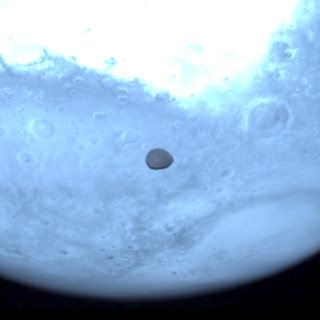
Comparing images of the Didymos system before and after the 2022 impact of NASA’s DART mission. The left-side image is a view from the DART spacecraft’s main DRACO camera shortly before impact. The right-side image is a view from Hera’s Asteroid Framing Camera, aiming to match the previous mission’s view angle as closely as possible. Credits: NASA/JohnsHopkings APL (left image); ESA/AFC (right image).
On September 2022, the NASA DART probe impacted asteroid Dimorphos. After a two-year journey, the Hera spacecraft has arrived to the system and obtained unprecedented images of its current status after the impact.
Dimorphos, the smaller (~150 m) of the two asteroids that form the binary system Didymos, was the main target of the NASA’s Double Asteroid Redirection Test (DART). It was impacted by the 576 kg DART probe at a velocity of 6.1 km/s, as part of a kinetic impactor test, the first Planetary Defence experiment to modify the orbit of an asteroid: the impact reduced the orbital period of Dimorphos around Didymos by 33 minutes, from 11.92 to 11.37 hours.
The images obtained by the suite of instruments onboard the Hera spacecraft at its arrival to the system in October 2026, show one side of Dimorphos entirely transformed, with its once rounded face flattened into a crater that seems as wide as the impacted face of the asteroid. Julia de León and George Prodan, researchers at the Instituto de Astrofísica de Canarias, participate in the Hera mission. “The crater is very big, and seems to have some weird structures inside it”, says de León. The larger body, Didymos (~730 m) appears to have undergone no apparent modifications from the DART impact, with the same boulder fields and the same central equatorial ridge.
A colour view of the asteroids: HyperScout-H
In addition to the high-resolution images, that will provide a wealth of information on the geomorphology on the sufaces of the two bodies, Hera carries other instruments that allow the study of different surface properties like the temperature or the composition. That’s the case of the HyperScout-H instrument, a hyperspectral camera that contains a detector covered by a thin layer of material in which there are 25 interference filters, in a 5x5 pixels matrix configuration, covering a wavelength range from 661 to 952 nm. This multispectral instrument performs mineral prospecting on the two asteroids by building up an image using 25 separate spectral bands – extending from the red seen by human vision into the near infrared. Julia de León is the HyperScout-H Instrument Scientist. George Prodan is part of the instrument team. “This is a very powerful instrument: we can obtain an image with a good spatial resolution to identify surface features (boulders, craters, etc) and, at the same time, information on the minerals and the degree of alteration they have experienced”, explains Prodan.

This Hyperscout-H false colour image shows how this multispectral instrument performs mineral prospecting on the two asteroids by building up an image using 25 separate spectral bands – extending from the red seen by human vision into the near infrared. This image was acquired on 3 November at a distance of 32.8 km away, with a spatial resolution of 4.3 m per pixel. Credits: ESA/HyperScout-H.
More than a simple impact: flying boulders
But the HyperScout-H camera is not only mapping the surface composition of the system. Its large field of view has allowed to image what seems to be hundreds of boulders of differing sizes in motion around the Didymos-Dimorphos system. “It is mindblowing. Of course we were ready to see material orbiting the system after such an impact, but this exceeds our best expectations”, comments de León.

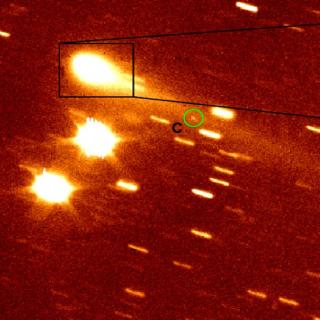
Composite image combining 11 long-exposure Hyperscout-H images, centred on the Didymos asteroid. The dot trails correspond to hundreds of boulders of differing sizes in motion around the Didymos-Dimorphos system. The two asteroids have been subtracted from the image for improved visualisation of the boulders. These images were acquired on 6 November with an approximate distance of 29.9 km from the asteroids. Credits: ESA/HyperScout-H.
The Hera mission will continue studying the system until June 2027, getting closer to the asteroids and acquiring images with a level of detail of several centimeters. “We are going to have so much fun analysing these data”, concludes de León.
ESA press release