
An international team led by researchers at the Kavli Institute for Cosmology at the University of Cambridge, and including scientists from the Instituto de Astrofísica de Canarias (IAC), has discovered a nearby analogue of the enigmatic “Little Red Dots”. This finding opens a new window on how supermassive black holes formed and grew in the early Universe. Observations with the Gran Telescopio Canarias have been crucial to characterizing this object.
Little Red Dots (LRDs hereafter) are among the most interesting discoveries of the James Webb Space Telescope (JWST). First identified at great cosmic distances—when the Universe was less than 1.5 billion years old—these compact objects appear to host rapidly growing supermassive black holes, yet behave very differently from nearby active galaxies.
Now, in a major breakthrough, two independent international teams, one of them led by Roberto Maiolino at the Kavli Institute for Cosmology, have identified the first nearby examples of LRDs, located just a few thousand million light-years from Earth. This discovery allows astronomers to study these objects in unprecedented detail, allowing them to understand how some of the Universe’s earliest black holes formed and grew so quickly.
A cosmic mystery from JWST
LRDs were first identified in deep JWST surveys as faint, compact galaxies in the distant universe, in the epoch usually known as Cosmic Dawn. They show strong hydrogen emission lines, often with broad components indicative of fast-accreting supermassive black holes. However, unlike typical active galactic nuclei, they are surprisingly weak in X-ray and infrared emission, challenging models of black hole growth and making researchers question the existence of supermassive black holes in them.
A crucial clue to their nature came from the discovery that many Little Red Dots show absorption features in their hydrogen emission lines. This means that although these objects emit an intense glow due to hot hydrogen, they are surrounded by cooler gas that absorbs part of that energy. This discovery indicates that indeed, the objects are accreting black holes enshrouded by dense envelopes of gas that absorb and reshape their emitted light. The problem is that determining the properties of this dense gas in the early Universe is extremely difficult.
Little Red Dots in our cosmic backyard
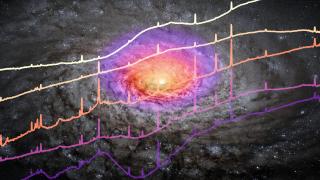
The discovery of LRDs located just a few thousand million light-years from Earth has changed the picture dramatically, allowing them to be studied with a level of detail inaccessible in the early Universe. Observations with the Gran Telescopio Canarias (GTC) at the Observatorio del Roque de Los Muchachos, in La Palma, of the closest LRD, revealed faint emission lines from ionized iron, indicating exceptionally dense gas surrounding the black hole. Similar features have since been identified in a handful of distant LRDs, strengthening the connection between local and early-Universe populations.
“These local Little Red Dots are unique laboratories,” says X. Ji, researcher at the Kavli Institute for Cosmology and lead author of the study, “They allow us to study, in exquisite detail, the dense gas environments that may have enabled black holes to grow rapidly in the early Universe.”
Although the current sample of nearby Little Red Dots is small, the implications are far-reaching. Expanding the search for these objects will be crucial for understanding how common they are and how they fit into the broader picture of galaxy and black hole evolution. IAC researcher and co-author of the article Cristina Ramos Almeida explains: “We have recently been awarded 30 hours of GTC time to expand the sample of local Little Red Dots and study their gas envelopes, tripling the current statistics. This will be crucial to improve our understanding of their high redshift counterparts.”
Scientific article: X. Ji et al: “Lord of LRDs: insights into a 'Little Red Dot' with a low-ionization spectrum at z = 0.1”, Monthly Notices of the Royal Astronomical Society, 2026. DOI: https://doi.org/10.1093/mnras/staf2235
Contact at the IAC:
Cristina Ramos Almeida, cra [at] iac.es (cra[at]iac[dot]es)
Jose Antonio Acosta Pulido, jap [at] iac.es (jap[at]iac[dot]es)
Contact at the Kavli Institute for Cosmology:
Xihan Ji, xj274 [at] cam.ac.uk (xj274[at]cam[dot]ac[dot]uk)