
The Instituto de Astrofísica de Canarias (IAC), through its IACTEC Space department, took part in a new edition of the 4S Symposium (Small Satellites Systems and Services), one of Europe’s leading technical forums dedicated to small satellites, their applications and associated services. The meeting, held in Sardinia, brings together representatives from industry, academia and space agencies to address missions, advanced technologies and new applications in the field of small satellites.
Under the slogan “Swarming the Skies, Soaring Beyond: from VLEO to Deep Space”, this year’s programme included technical sessions on mission and systems analysis, Earth observation, telecommunications, navigation and new technologies, as well as exhibition and networking activities. The 4S Symposium has established itself over nearly three decades as one of Europe’s main technical exchange forums on small satellites and space services.
The IAC’s participation in this forum is part of the work of IACTEC Space, the Institute’s department focused on the development of advanced instrumentation for small satellites, both for Earth observation and astrophysics, as well as on the analysis and use of satellite imagery. Through this line of work, the Institute brings together capabilities in instrument development, Earth observation, data processing and technology transfer. Its main projects include IACSAT-1 / DUNE, ALISIO-1, collaboration with the Canary Islands Constellation, the DRAGO family of cameras and complementary developments such as FALCO.
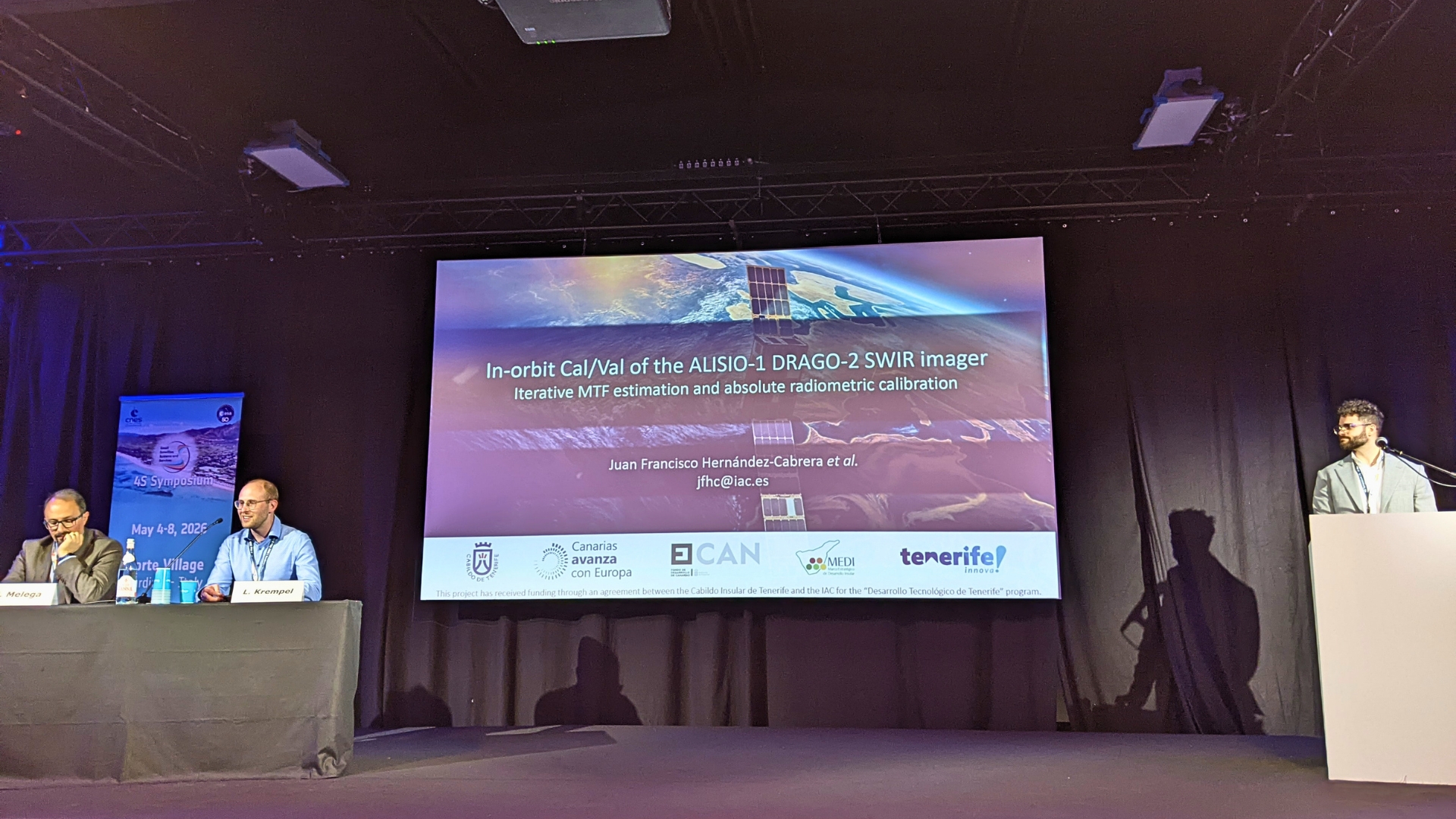
One of the papers presented at the symposium was the talk by Juan Francisco Hernández Cabrera, entitled “In-orbit Cal/Val of the ALISIO-1 DRAGO-2 SWIR imager: Iterative MTF estimation and absolute radiometric calibration”. The presentation focused on the in-orbit calibration and validation of the DRAGO-2 infrared camera aboard ALISIO-1, the first Canary Islands Earth observation satellite, which has been operating for almost three years and demonstrating its technological capability.
Alongside the in-orbit calibration contribution presented by Juan Francisco Hernández Cabrera, the IAC’s presence at the 4S Symposium included two posters by Carlos Colodro Conde. The first presented software designed to help fulfil the PUS standard (Packet Utilization Standard) in space communications. This contribution broadens the scope of IACTEC Space beyond instrument development and strengthens its work on support tools for space systems. The second presented the “dark current correction method for uncooled cameras”, a patented technology developed by the IAC within IACTEC Space to improve image quality in sensors exposed to thermal variations.
This technology has been validated in three space missions through its use in the DRAGO cameras developed by the IAC for Earth observation. In addition to its use in the space sector, the system also has potential applications in other fields where thermal conditions affect sensor performance, as part of a broader strategy for the exploitation and transfer of technological results.
The Instituto de Astrofísica de Canarias’ presence at the 4S Symposium strengthens the profile of IACTEC Space in a specialised forum where technical developments, mission results and new capabilities for small satellites converge. In this context, the IAC’s contributions highlight two complementary aspects of its work: on the one hand, the in-orbit validation of its own instrumentation, as in the case of ALISIO-1 and DRAGO-2; and on the other, the development of transferable technologies with a wider reach beyond a single mission, as is the case with the patented dark current correction method.
With this participation, the IAC continues a line of work in which research and instrument development are translated into technological capabilities with space applications and transfer potential. Through IACTEC Space, one of the laboratories within the CELESTE project, the Institute consolidates a model that connects science, engineering and the operational use of data in the field of small satellites and Earth observation, while also reinforcing its commitment to developing strategic space technology capabilities in the Canary Islands.