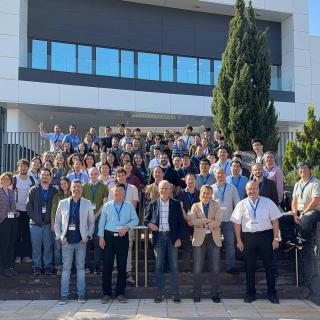

A delegation from the Instituto de Astrofísica de Canarias (IAC), led by its Director, Valentín Martínez Pillet, is attending the Big Science Industry Forum Spain 2025 (BSIFS2025), the main national meeting dedicated to the Big Science Industry, on 3 and 4 December. The team is presenting the centre’s scientific and technological advances and strengthening strategic links with companies, technology centres and international scientific infrastructures.
The IAC strengthens its presence at Spain’s largest Big Science Industry forum
The Big Science Industry Forum Spain 2025, organised by CDTI Innovación together with INDUCIENCIA and INEUSTAR, brings together at IFEMA (Madrid) the main stakeholders in big science, including major infrastructures such as the European Organization for Nuclear Research (CERN), the European Southern Observatory (ESO), the ITER project and its European agency F4E, as well as technology companies and research centres from across the country. The event seeks to strengthen national capabilities in the Big Science Industry, boost Spanish participation in international projects and promote technology transfer.
Representing the IAC are Director, Valentín Martínez Pillet, Deputy Director, Eva Villaver, Teide Observatory Administrator, David Nespral, Head of OTAI, Anselmo Sosa, Head of the Space Department, Álex Oscoz, and Head of the Optics Department, José Luis Rasilla, who took part in various panel discussions, presented the centre’s activities at the ICTS stand and at the IACTEC-Space stand, and held bilateral meetings with institutions and companies in the sector to identify synergies and emerging opportunities in scientific instrumentation, Earth observation and advanced astrophysical and space technologies.
The IAC’s Director, Valentín Martínez Pillet, highlights the importance of this meeting for the national scientific ecosystem: “BSIFS2025 is a unique opportunity to strengthen the IAC’s position within the Big Science Industry and to drive collaborations that enable us to continue transferring our knowledge and technological capabilities to society as a whole. Participation in forums such as this is essential to consolidating partnerships and anticipating the scientific and technological challenges of the coming years.”
As Deputy Director of the Instituto de Astrofísica de Canarias (IAC), Eva Villaver took part in the plenary session entitled “How to attract talent to the Big Science Industry?” within the BSIFS2025 forum. Villaver stressed the IAC model as a well-established example of success in attracting and exporting scientific and technological talent, a model built up and strengthened over more than 40 years of activity. She also underlined the need to design specific mechanisms for assessing technological careers, noting that they cannot be measured using the same criteria as traditional academic careers. Finally, she called for greater involvement of private investment in the training and development of talent, emphasising that private-sector collaboration is key to ensuring the sustainability and competitiveness of the Big Science sector in Spain.
For his part, Álex Oscoz, Head of the IACTEC-Space Department, underlines the strategic value of attending this type of event: “For a team like ours, which develops cutting-edge space instrumentation, it is essential to be present at the major Big Science Industry forums. This is where connections are forged, opportunities are explored and efforts are aligned with companies and institutions that can drive our missions and projects. Attending this forum is key to ensuring that the Canary Islands continue progressing as a space sector reference.”

Álex Oscoz Head of the Space Department (IAC) at BSIFS2025
In addition, during the forum, the IACTEC-Space team presented the advances of DRAGO-3, the new generation of SWIR cameras that will form part of the Canary Islands Constellation (CIC), promoted by the Island Council of Tenerife, as well as the development of the compact VINIS telescope, capable of obtaining high-resolution images in the visible, NIR and SWIR ranges, and the progress of the IACSAT-DUNE microsatellite.
A key forum for driving public–private collaboration in Spain
BSIFS2025 is consolidating itself as a strategic space for building partnerships between companies, research centres and large-scale science infrastructures, bringing together procurement opportunities, technological trends and national capabilities in a single common showcase. The Big Science Industry moves billions of euros a year and generates cutting-edge technologies, from ultra-high-vacuum systems to high-performance computing.
In this context, the participation of the IAC reinforces its leadership in the Big Science Industry sector. The IAC is the managing body of one of Spain’s most important Singular Scientific and Technical Infrastructures (ICTS): the Canary Observatories —with the telescopes at the Teide Observatory (Tenerife) and the Roque de los Muchachos Observatory (La Palma)—, in addition to playing a key role in the Gran Telescopio Canarias (GTC) and hosting a computing node of the Spanish Supercomputing Network (RES) in La Palma. These unique facilities, conceived for frontier science, require substantial investment; however, they offer world-class research and technological development capabilities. By serving the entire scientific community —with both national and international collaboration— these ICTS enable progress in key areas such as astrophysics and advanced computing. Thanks to this consolidated scientific and technological ecosystem, the Canary Islands reaffirm their leading role in international astronomy, cutting-edge research and high-performance computing.