GRANCAIN: First scientific INfrared CAmera for Adaptive Optics of GTC

Start year
2021
End year
2026
Organizational Unit
    General
    Description

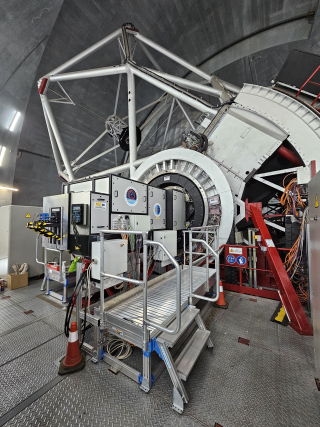
    GRANCAIN is a near-infrared scientific camera developed to operate with the Adaptive Optics system of the Gran Telescopio Canarias (GTC), enabling it to reach the diffraction limit and provide the best spatial resolution from the ground.

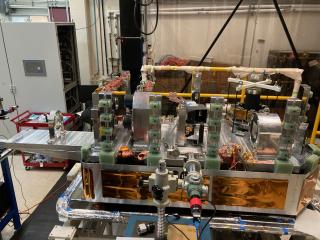
    Conceived as a strategic and transitional instrument, GRANCAIN supports the commissioning of the GTC's Adaptive Optics system (GTCAO) while ensuring the continuity of near-infrared scientific capabilities until FRIDA is fully operational. Its development reflects an efficient and sustainable approach: the instrument was assembled using repurposed components from previously decommissioned systems and was financed by the European Recovery and Resilience Facility, maximizing existing technological assets and optimizing development time and costs.

    In May 2025, GRANCAIN was formally accepted into the Assembly, Integration and Verification (AIV) facilities of the Instituto de Astrofísica de Canarias (IAC). In October, it was installed on the GTC, successfully completing its integration with the Adaptive Optics system on the Nasmyth B platform. In November 2025, the instrument passed its technical verification using the calibration source of GTCAO and obtained its first acquisition image in December, marking the beginning of its operational phase.

    During 2026, sky verification activities will focus on optimizing the combined performance of the GTCAO and the telescope to achieve maximum spatial resolution. Until FRIDA becomes fully operational, GRANCAIN will work as a scientific instrument, reinforcing the observatory's capabilities, consolidating the operation of Adaptive Optics, and ensuring a sustained scientific return and the international competitiveness of the GTC.

    Principal investigator
    Co Principal investigator
    Project manager
    Project staff
    Collaborators
    Related projects
    GTCAO installed at the Nasmyth B platform of GTC telescope
    GTCAO LGS. Adaptative Optics and Laser Guide Star for GTC
    The Adaptive Optics (AO) for the Gran Telescopio Canarias (GTC) corrects the effect of the atmospheric turbulence on the light, to exploit the high spatial resolution capability of GTC. The Laser Guide Star (LGS) extends the coverage of GTCAO to any part of the sky, increasing dramatically the capability to do high spatial resolution science.
    Víctor Javier
    Sánchez Bejar
    System level integration and tests of FRIDA
    FRIDA - inFRared Imager and Dissector for Adaptive optics
    FRIDA (inFRared Imager and Dissector for Adaptive optics) is an integral field spectrograph in the near infrared, also with image mode, which will be installed in the GTC telescope. It will use the adaptive optics system of GTC (GTCAO) to observe with very high spatial resolution and spectral resolutions of up to 30,000.
    Almudena
    Prieto Escudero
    Capability
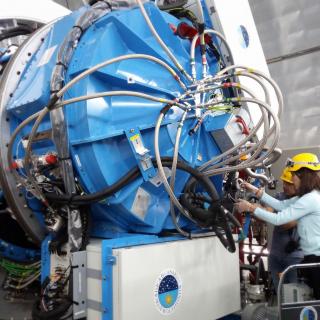
    Rear view of the EMIR instrument in GTC with engineers working on the cryogenic system. Large cylindrical structure with metallic tubes and electronic controls
    Design, development and manufacture of cryogenic and vacuum systems
    The astronomical observation in the infrared range of the spectrum requires the use of cryogenic systems where high vacuum and very low temperature technologies are combined.
    Related Technical facility
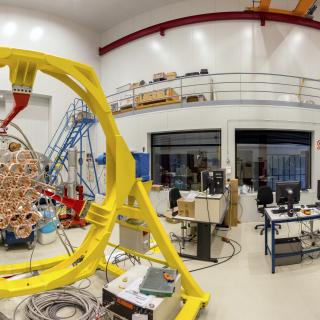
    Panoramic view of one the areas of the Assembly, Integration and Verification room. Large laboratory with work benches and multiple electronic devices and computers, with a large mechanical structure in assembly phase
    Large Instruments Assembly, Integration and Verification Room (AIV)
    The purpose of the AIV Room is the assembly, integration and verification of instrumentation for large telescopes.
    José Miguel
    Delgado Hernández