
Bibcode
Meschin, I.; Gallart, C.; Aparicio, A.; Cassisi, S.; Rosenberg, A.
Bibliographical reference
The Astronomical Journal, Volume 137, Issue 3, pp. 3619-3631 (2009).
Advertised on:
3
2009
Citations
9
Refereed citations
8
Description
Observations of the resolved stars obtained over a period of 11 years in
the Local Group dwarf irregular galaxy Pegasus have been used to search
for Cepheid variable stars. Images were obtained in 55 epochs in the V
band and in 24 epochs in the I band. We have identified 26 Cepheids and
have obtained their light curves and periods. On the basis of their
position in the period-luminosity (PL) diagram, we have classified them
as 18 fundamental modes and eight first overtone Cepheids. Two PL
relations for Cepheids have been used to derive the distance, resulting
in 1.07 ± 0.05 Mpc. We present the VARFINDER code which finds the
variable stars and their predicted periods in a given synthetic
color-magnitude diagram computed with IAC-star and we propose the use of
the Cepheid population as a constraint of the star formation history of
Pegasus.
Related projects
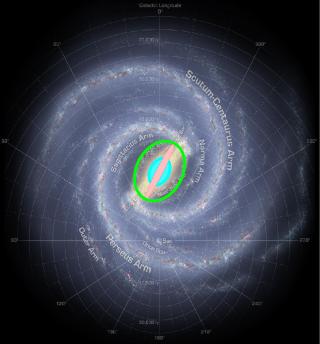
Milky Way and Nearby Galaxies
The overall aim of the project is to study the morphology, stellar populations, kinematics and dynamics (including formation and evolution) of the Milky Way and its satellite galaxies and other Local Group galaxies. The project can be divided into two main lines: I. Structure of the Milky Way and nearby galaxies. The detailed study of the
Martín
López Corredoira