
Bibcode
Aparicio, Antonio; Hidalgo, Sebastian L.
Bibliographical reference
The Astronomical Journal, Volume 138, Issue 2, pp. 558-567 (2009).
Advertised on:
8
2009
Citations
94
Refereed citations
81
Description
IAC-pop is a code designed to solve the star formation history (SFH) of
a complex stellar population system, like a galaxy, from the analysis of
the color-magnitude diagram (CMD). It uses a genetic algorithm to
minimize a χ2 merit function comparing the star
distributions in the observed CMD and the CMD of a synthetic stellar
population. A parameterization of the CMDs is used, which is the main
input of the code. In fact, the code can be applied to any problem in
which a similar parameterization of an experimental set of data and
models can be made. The method's internal consistency and robustness
against several error sources, including observational effects, data
sampling, and stellar evolution library differences, are tested. It is
found that the best stability of the solution and the best way to
estimate errors are obtained by several runs of IAC-pop with varying the
input data parameterization. The routine MinnIAC is used to control this
process. IAC-pop is offered for free use and can be downloaded from the
site http://iac-star.iac.es/iac-pop. The routine MinnIAC is also offered
under request, but support cannot be provided for its use. The only
requirement for the use of IAC-pop and MinnIAC is referencing this paper
and crediting as indicated in the site.
Related projects
Milky Way and Nearby Galaxies
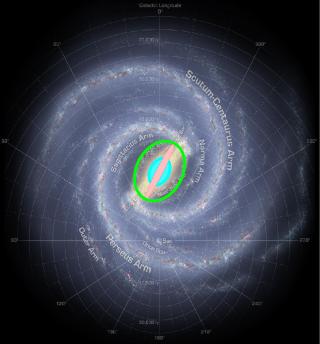
The overall aim of the project is to study the morphology, stellar populations, kinematics and dynamics (including formation and evolution) of the Milky Way and its satellite galaxies and other Local Group galaxies. The project can be divided into two main lines: I. Structure of the Milky Way and nearby galaxies. The detailed study of the
Martín
López Corredoira