
Bibcode
Navarro, A.; Khomenko, E.; Vitas, N.; Felipe, T.
Bibliographical reference
Astronomy and Astrophysics
Advertised on:
11
2025
Journal
Citations
0
Refereed citations
0
Description
Context. Modeling the solar atmosphere is challenging due to its layered structure and dynamic multi-scale processes. Aims. We aim to validate the new radiative magnetohydrodynamic (MHD) code MAGEC—built by integrating the MANCHA3D and MAGNUS codes into a finite-volume, shock-capturing framework—and to explore its capabilities through 2D simulations of magnetoconvection in the solar atmosphere. Methods. The MAGEC code is parallelized with Message Passing Interface (MPI), enabling efficient scalability for large-scale simulations. We have enhanced it with advanced numerical techniques to address the specific complexities of the solar corona, including a module for local thermodynamic equilibrium (LTE) radiative coronal losses. To address the small time steps due to large heat flux values, we adopted the hyperbolic treatment for the thermal conduction of MANCHA3D, which significantly improves the computational times. In addition, we estimated the effective numerical resistivity and viscosity through a dedicated set of experiments. To evaluate the robustness and accuracy of MAGEC, we performed a series of 2D simulations covering a domain extending from 2 Mm below the solar surface to 18.16 Mm into the corona. Simulations were conducted with both open and closed magnetic field configurations. For each case, we analyzed the resulting steady-state temperature profiles and examined the energy contributions at different heights. In addition, we investigated the influence of the perpendicular component of thermal conduction in a dedicated simulation. Results. The MAGEC code effectively reproduced expected temperature profiles based on the boundary conditions applied and the imposed magnetic field configuration. All simulations reached a thermally stable state. When using an open vertical magnetic field, the temperature in the middle corona was higher than in the case with a closed, arcade-like magnetic field structure. We quantified the contributions to the internal energy from all explicit and implicit terms in the steady state, both in terms of temporal averages and as functions of height, as well as their relative contributions to total heating and cooling. In a second phase of the study, we investigated the role of the perpendicular component of thermal conduction, which is often neglected in coronal models, and found that it can influence plasma dynamics around reconnection events. Although local effects are modest, their cumulative impact can lead to measurable changes in the average temperature profile. Conclusions. Through detailed validation, MAGEC is a reliable and efficient code for radiative MHD simulations of the solar atmosphere. The integration of shock-capturing methods is particularly well suited to modeling the plasma environment, effectively handling the shocks and discontinuities characteristic of the solar atmosphere. MAGEC is a robust tool for high-fidelity magneto-convection simulations of the solar atmospheric dynamics.
Related projects
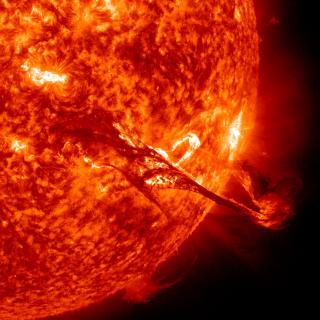
Solar and Stellar Magnetism
Magnetic fields are at the base of star formation and stellar structure and evolution. When stars are born, magnetic fields brake the rotation during the collapse of the mollecular cloud. In the end of the life of a star, magnetic fields can play a key role in the form of the strong winds that lead to the last stages of stellar evolution. During
Carlos Cristo
Quintero Noda

Numerical Simulation of Astrophysical Processes
Numerical simulation through complex computer codes has been a fundamental tool in physics and technology research for decades. The rapid growth of computing capabilities, coupled with significant advances in numerical mathematics, has made this branch of research accessible to medium-sized research centers, bridging the gap between theoretical and