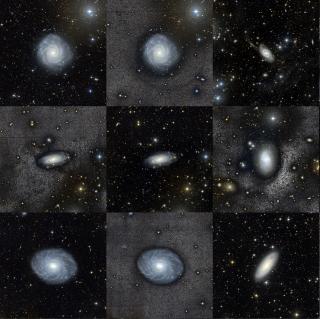

In the standard Lambda cold dark matter (Lambda-CDM) cosmology, galaxies grow by gradually accreting material and through mergers with other galaxies. This scenario successfully explains many large-scale cosmic structures, yet it struggles to account for the existence of numerous massive spiral galaxies in the local Universe that lack a prominent central bulge, pure disc systems, in the local Universe. Understanding how these galaxies form and survive is also essential for placing our own Galaxy, the Milky Way, into context, as it also hosts a low-mass bulge.
In this study, we analyse 22 nearby bulgeless galaxies as part of the BEARD survey. Using very deep surface-brightness images — reaching down to 30 mag arcsec^-2 — we trace their faint outer regions with unprecedented detail. These observations, obtained with the 2.5 m Isaac Newton Telescope, allow us to define galaxy sizes using the radius R1, defined as the galactocentric distance where the stellar mass surface density reaches 1 solar mass per square parsec. This definition has been introduced by Trujillo et al. (2020) as an empirical proxy for the physical edge of in situ star formation, and therefore provides a meaningful estimate of galaxy size.
We find that these bulgeless galaxies follow a remarkably tight relation between their stellar mass and size. By comparing our results with state-of-the-art cosmological simulations, we show that the observed diversity in galaxy sizes is linked to their internal structure and past interactions. In particular, galaxies without bulges appear to have experienced mergers in configurations that allowed their discs to survive and to reside in dark matter halos with slightly higher angular momentum.