
An international team of astronomers, led by the IAC’s Substellar researcher Marusa Zerjal, has released a striking new census of ultracool dwarfs - the faintest, lowest-mass stars and brown dwarfs. They used data from the Quick data release (Q1) of the Euclid space telescope. While the main mission of Euclid is to observe distant galaxies and explore the dark universe, its sensitive instruments simultaneously catch faint objects in the Solar neighbourhood. In their new work, astronomers have shown that the reddest point-like objects in Euclid are in fact ultracool dwarfs.
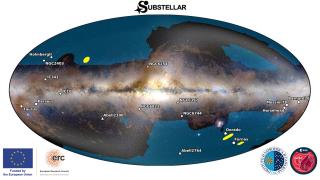
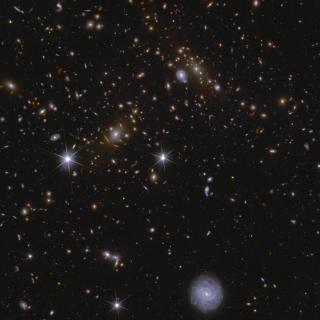
Euclid’s Q1 catalogue is focused on three Euclid Deep Fields - one in the northern hemisphere, and two in the south. It contains 30 million sources, and most of them are of extragalactic origin - distant galaxies and quasars. Astronomers had to use morphological filtering to extract point-like sources. It was like looking for a needle in a haystack.
The study has been accepted for publication in Astronomy & Astrophysics and reports more than 5,000 new ultracool dwarf (UCD) candidates, spanning spectral types from late M to L and late T. It includes some 1,200 L-type and T-type dwarfs. Over 500 of these candidates have been spectroscopically confirmed in the associated work by Carlos Dominguez-Tagle and collaborators.
This landmark catalogue marks a major leap forward in the study of substellar populations. Thanks to Euclid’s depth, sky coverage, and sensitivity, astronomers now have access to an unprecedented dataset to explore the population statistics, formation, and distribution of ultracool dwarfs across the Galaxy.
This first analysis enabled astronomers to project the numbers to the full survey coverage of the Euclid Wide Survey after 6 years of observations. They estimate the final dataset could contain at least 1.4 million ultracool dwarfs, including more than 300,000 L dwarfs and over 2,600 T dwarfs. This will dramatically increase the known population, and enable the first large scale population studies. We expect to see the first major Euclid’s data release, covering 30x larger area in the sky, in October next year.