
Artistic impression of the "eclipse" due to the newly found super-Jupiter or brown dwarf with massive rings (foreground) forming an opaque "saucer" through which some light from the star ASASSN-24fw (background) shines. A red dwarf star (left) was also discovered in the neighbourhood during the research. Creatoactive Solutions
An international scientific team, involving the University of La Laguna (ULL) and the Instituto de Astrofísica de Canarias (IAC), has identified the cause of an unusually long dimming of a distant star. The phenomenon is explained by the passage of a substellar object with a giant ring system, similar to a ‘cosmic saucer’, in front of the host star.
The star, named ASASSN-24fw, is located in the Monoceros constellation at about 3,000 light-years away from Earth. The star faded steadily for more than nine months between late 2024 and mid-2025 to about 97% dark before returning to its normal brightness. Such stellar eclipse events are extremely rare. Most of them last only a few days or weeks, but this dimming continued for nearly 200 days, making it one of the longest ever observed.
ASASSN-24fw is about 50% more massive than our sun and about twice as big. It is known that the star itself is stable and not prone to sudden changes. This rules out internal stellar activity as the cause of the strange dimming. Instead, a recently released detailed analysis of various observations supports that it was caused by a large companion object moving across our line of sight to the star, blocking its light for a significantly long period.
The study was carried out by an international team of astronomers, including Sarang Shah, a post-doctoral researcher at the Inter-University Centre for Astronomy and Astrophysics (IUCAA; Pune), Jonathan Marshall, an independent researcher affiliated with Academia Sinica (Taiwan), and Carlos del Burgo, a researcher of ULL and IAC.
Carlos del Burgo says: "An extraordinarily deep dimming was first detected in the light curve —intensity against time— of ASASSN-24fw provided by the All-Sky Automated Survey for Supernovae (ASAS-SN). This event caught our attention and we monitored the star and collected additional data to characterise it and model the long transit, unveiling some treasures held in the stellar surroundings.”
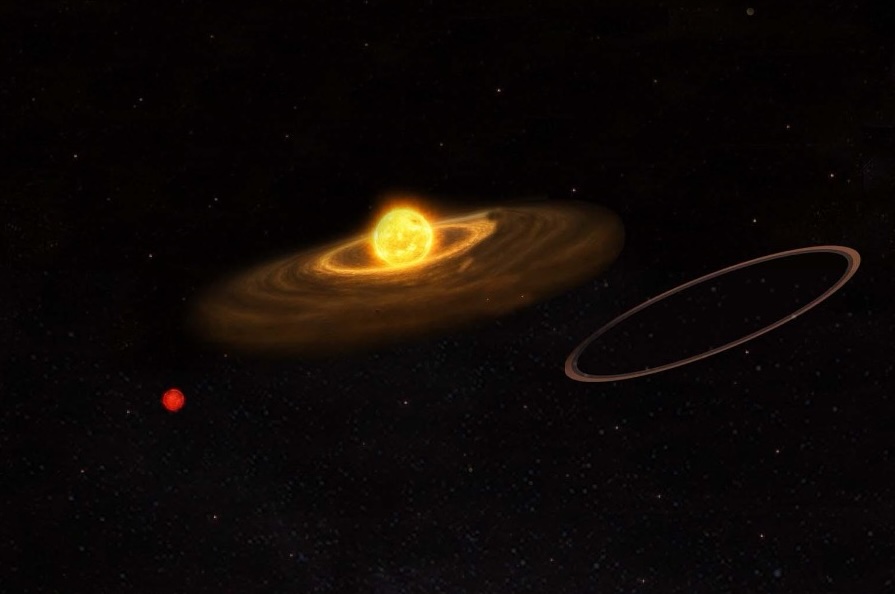
"Various models made by our group show that the most likely explanation for the dimming is a brown dwarf — an object heavier than a planet but lighter than a star — surrounded by a vast and dense ring system. It is orbiting the star at a farther distance with the ring." adds Sarang Shah. "Long-lasting dimming events like this are exceptionally uncommon as they require very perfect line-ups. The dimming began gradually because the outer parts of the rings are thin, and only became obvious when the denser regions passed in front of the star."
Analysis of photometric and spectroscopic studies of the event suggests that the companion object has a mass of more than three times that of Jupiter. Its ring system is remarkably big, extending to about 0.17 astronomical units, comparable to half the distance between the Sun and Mercury. The analysis also shows that ASASSN-24fw itself also has a circumstellar environment (possibly remnants from past or ongoing planetary collisions) very near to it, which is unusual for a star of its age (around a few thousand million years).
“Large ring systems are expected around massive objects, but they are very difficult to observe directly to determine their characteristics" explains Jonathan Marshall. "This rare event allows us to study such a complex system in remarkable detail. In fact, while studying this dimming, we also serendipitously discovered that ASASSN-24fw also has a red dwarf star in its vicinity."
The discovery thus provides an important opportunity to better understand sub-stellar companions like brown dwarfs, massive ring systems, and how such structures form and evolve around stars. We plan to perform future observations to study this system in detail using large telescopes like JWST, ALMA, VLT etc.
This work made use of the publicly available data from All-Sky Automated Survey for Supernovae (ASAS-SN), a global network of robotic telescopes designed to image the entire visible sky every night to detect bright transients and variable stars. It also used data from the Asteroid Terrestrial-impact Last Alert System (ATLAS), NASA's robotic asteroid early warning system. In addition, the authors also obtained proprietary photometric and spectroscopic data from renowned facilities like the W. M. Keck Observatory, Magellan Telescope, and Las Cumbres Observatory Global Telescope (LCOGT).
Article: Sarang Shah et al. "The nature of ASASSN-24fw's occultation: modelling the event as dimming by optically thick rings around a sub-stellar companion". Monthly Notices of the Royal Astronomical Society, 2026. DOI: https://doi.org/10.1093/mnras/staf2251
Contact at the IAC:
Carlos del Burgo, cburgo [at] ull.edu.es (cburgo[at]ull[dot]edu[dot]es)