On the occasion of International Dark Matter Day, the IAC transversal project “Dark matter: observations, models and detection” — coordinated by G. Battaglia — celebrated its first internal workshop on October 29th at the Instituto de Astrofísica de Canarias (IAC), with the support of the DiaLoGues project.
The IAC transversal project “Dark matter: observations, models and detection”, created in 2026, brings together IAC researchers with complementary expertise united by a common goal: understanding the fundamental nature of dark matter (DM), one of the main constituents of the Universe. Determining what DM actually is has been identified as a priority for the future of astrophysics, cosmology and particle physics, driving extensive observational and theoretical efforts worldwide.
Twenty-four participants — PhD students, postdocs, and permanent staff — gathered to share their latest results across no fewer than 20 presentations, showcasing the project’s remarkably broad and multidisciplinary approach to the DM puzzle.
Three lines of research to tackle a great mystery
The workshop was structured around the three main lines of attack of the project: gravitational probes that trace the distribution and dynamical influence of dark matter (e.g. structure and dynamics of dwarf galaxies, streams, wakes, strong and weak lensing); numerical simulations that explore how dark matter shapes structure formation; and its interplay with baryonic matter; and direct and indirect searches for dark matter signals from interactions, annihilation or decay.
Presentations explored improvements in dynamical modeling of Local Group dwarf galaxies — the smallest and most dark-matter-dominated galaxies known — incorporating machine learning approaches, multiple kinematic tracers, and careful assessment of systematic effects such as undetected binary stars. Complementary work investigated novel modelling approaches to the wakes induced by orbiting satellites in the stellar and dark matter haloes of the Milky Way. The crucial role of current and upcoming facilities including WEAVE, 4MOST, Euclid and Gaia in dynamical modeling and related aspects was highlighted.
A thought-provoking talk asked “what if dark matter lives in the nightmare scenario” of limited data and modelling assumptions driving some of the effects that we attribute to the nature of DM, challenging the audience to critically examine the assumptions underlying gravitational DM probes, from stellar kinematics to strong and weak gravitational lensing. This was further illustrated by the interpretation of current strong gravitational lensing observations, which, when carefully accounting for the underlying Cold Dark Matter assumptions, are not necessarily in tension with this paradigm, despite claims of apparent discrepancies.
Another contribution presented a study of how mergers that occurred in the infancy of the Milky Way can shape its DM distribution, with implications for direct detection experiments and for stellar streams — and outlined an original idea to test the strong equivalence principle - one of the pillars of general relativity - using globular clusters.
On the topic of globular clusters, a dedicated talk addressed the challenge of predicting gamma-ray emission from millisecond pulsars in these systems — a crucial baseline for identifying any excess signal that could betray DM annihilation in clusters that may retain a compact DM component as remnants of accreted dwarf galaxies. Efforts aimed at mapping the stellar distribution of dwarf galaxies and extremely low surface brightness systems were discussed in the context of constraining the density profiles of DM halos.
Simulations to explore different dark matter scenarios
Part of the discussion centered on how next-generation simulations of cold and alternative DM models can help disentangle different DM scenarios, also highlighting the complexities related to the treatment of baryonic physics and the impact of resolution.
The first results of the NIVARIA constrained Local Group simulations run with the Gasoline2 code and NIHAO feedback model were presented, successfully reproducing the observed diversity in dwarf galaxy rotation curves. Predictions on a population of dark galaxies — low-mass systems with gas but no stars — inhabiting the low-density regions of the Local Group, potentially detectable through their neutral hydrogen emission, were presented.
New approaches to direct and indirect detection
On the indirect and direct detection front, investigations of the sensitivity of space-based radio antennas to resonant conversion of light dark matter around the Sun, Earth, and Jupiter, overcoming the ionospheric screening that limits ground-based searches, were discussed, with particularly promising prospects for dark photons in the Sun and axion-like particles in Jupiter’s magnetosphere.
The DMD+ group reviewed its current activities, including recent exclusion limits on axions and dark photons derived from DALI and ALMA observations of the Galactic Centre magnetar, and presented future directions such as the CCD2M concept — a proposal to exploit the silicon substrate of astronomical CCD cameras to search for GeV-scale WIMPs.
Dark matter, also a key topic in popular science
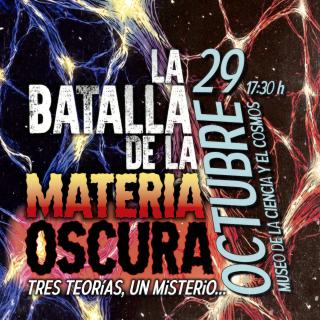
The day closed on a public note with the outreach event "La batalla de la materia oscura", held at the Museo de la Ciencia y el Cosmos — bringing the excitement of dark matter research to a wider audience and rounding off a day that made abundantly clear just how alive and diverse the hunt for dark matter is at the IAC.