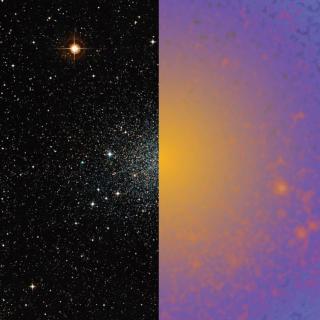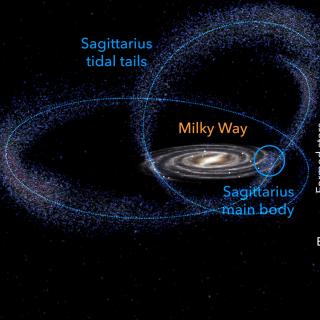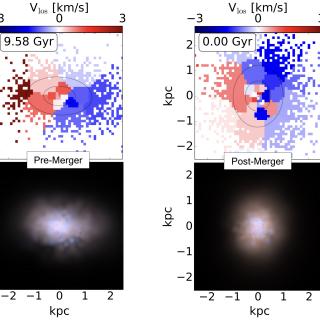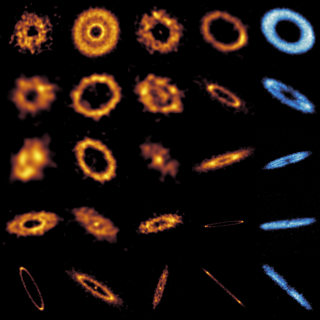

Dwarf galaxies spanning six orders of magnitude in stellar mass, with stellar mass decreasing towards the right and bottom. The Large Magellanic Cloud, WLM, and Pegasus are dwarf irregular galaxies that contain gas and continue to form stars today. The remaining six galaxies lack gas and currently show no star formation. The faintest galaxies shown in this image can only be detected in regions relatively close to the Milky Way. Of particular interest for this work are the final two galaxies, Eridanus II and Pictoris I, which fall within the category of ultra-faint galaxies. Image credits: Eckhard Slawik (LMC); ESO/Digitized Sky Survey 2 (Fornax); Massey et al. (2007; WLM, Pegasus, and Phoenix); ESO (Sculptor); Mischa Schirmer (Draco); Vasily Belokurov and Sergey Koposov (Eridanus II and Pictoris I). Composition: Bullock & Boylan-Kolchin (2017).
A team from the Instituto de Astrofísica de Canarias (IAC) has quantified for the first time the impact that the motions of binary stars can have on estimates of dark matter in some of the smallest galaxies in the universe. The study proposes a new methodology that will make it possible to obtain more precise measurements of the amount of dark matter present in these systems.
The Milky Way, our galaxy, contains hundreds of billions of stars. However, dozens of much smaller galaxies orbit around it, dwarf companions that host thousands of times fewer stars and live embedded within our galaxy’s dark matter halo. These systems are not only particularly interesting, but also belong to the most abundant type of galaxy in the universe.
Among them is an especially extreme group: ultra-faint galaxies, the smallest known galactic systems. These tiny galaxies contain millions of times fewer stars than the Milky Way and, in some cases, only a few hundred. They are considered the objects with the highest proportion of dark matter with respect to visible one in the universe, making them unique laboratories for studying this mysterious component. In fact, the inferred presence of dark matter is what makes it possible to distinguish them from simple stellar groupings or globular clusters.
However, there is a problem. The presence of dark matter is inferred by measuring the velocities of the stars in these galaxies: if they move too fast for the amount of visible matter present, there must be an additional source of gravity. But the orbital motions of binary stars—pairs of nearby stars that orbit one another and could account for up to 70 % of the stellar population—are often ignored in these analyses.
Now, a new study led by the Instituto de Astrofísica de Canarias (IAC) has revealed the extent to which the motions of binary stars can mimic the gravitational signal attributed to dark matter in some of the smallest galaxies in the universe.
A New Methodology for Measuring Dark Matter
To investigate this effect in detail, the team developed a new statistical methodology and applied it to a sample of ultra-faint galaxies orbiting the Milky Way. The results show that, once the effect of binary stars is taken into account, the estimated amount of dark matter decreases and, in some cases, the evidence for its presence is no longer conclusive. “Some objects that appeared to be galaxies could, in fact, simply be globular clusters containing binary stars, that is, systems without dark matter,” explains José María Arroyo-Polonio, an IAC researcher who led the study. “In other cases, although the evidence for dark matter remains clear, the estimated amount is significantly reduced,” he adds.
The study also indicates how this problem can be addressed: by observing the same stars at different times over periods of months or years. “These observations make it possible to identify hidden binaries and separate their influence from the true gravitational signal,” says Giuseppina Battaglia, an IAC researcher and co-author of the article.
“In other words, to understand the smallest galaxies in the universe, we must first make sure that we are not confusing the dance of stellar partners with the presence of dark matter,” concludes Guillaume F. Thomas, an IAC researcher and co-author of the study.
Article: José María Arroyo-Polonio, Giuseppina Battaglia, Guillaume F. Thomas. "Estimating the dynamical masses of dwarf galaxies in the presence of binary-star contamination". A&A, 708, A287 (2026). DOI: https://doi.org/10.1051/0004-6361/202558720
Contacts:
José María Arroyo-Polonio, jose.maria.arroyo [at] iac.es (jose[dot]maria[dot]arroyo[at]iac[dot]es)
Giuseppina Battaglia, giuseppina.battaglia [at] iac.es (giuseppina[dot]battaglia[at]iac[dot]es)
Guillaume F. Thomas. guillaume.thomas [at] iac.es (guillaume[dot]thomas[at]iac[dot]es)