

Comparison between an observed galaxy (right) and a simulated galaxy (left) showing similarities in mass and size.
Advertised on
A new study published in Astronomy & Astrophysics unveils a powerful way to determine the size of dark matter haloes—the massive, invisible structures that host galaxies—by simply measuring how large galaxies appear in deep astronomical images.
Researchers Ignacio Trujillo and Claudio Dalla Vecchia, from the Instituto de Astrofísica de Canarias (IAC) and the Universidad de La Laguna (ULL), demonstrate that galaxy size can serve as a precise proxy for halo size, offering measurements up to six times more accurate than previous methods.
Using the cutting-edge EAGLE cosmological simulations, the team showed that a physically motivated definition of galaxy size, based on where star formation naturally ceases, correlates extremely tightly with halo size. This breakthrough opens a new path for mapping dark matter in the universe.
“We are entering a new era of deep astronomical observations, where the faintest edges of galaxies become visible,” said Ignacio Trujillo. “These observations are powerful tools, allowing us to probe the properties of the dark matter haloes that shape galaxies, with unprecedented accuracy.”
“Numerical simulations have reached the point where they can robustly predict how galaxy sizes relate to their haloes,” added Claudio Dalla Vecchia. “This predictive power gives us confidence that we can use observational data to infer the invisible dark matter structures with remarkable precision.”
The findings suggest that by analyzing deep imaging surveys, astronomers will be able to chart the distribution and properties of dark matter haloes across cosmic time more accurately than ever before.
Article: and "An accurate measure of the size of dark matter haloes using the size of galaxies", A&A, 704, A312 (2025). DOI: https://doi.org/10.1051/0004-6361/202556635
Contact:
Related projects
Dark matter: observations, models and detection
This transversal project aims to explore the fundamental nature of one of the main constituents of the Universe: non-baryonic dark matter (DM). The nature of DM is one of the key questions in science. Its manifestation as an additional source of matter needed to explain astrophysical and cosmological observations implies either a breakdown of
Giuseppina
Battaglia
Related news

Ultra-faint dwarf galaxies, among the tiniest and faintest galaxies known, may hold the key to understanding one of the Universe’s biggest mysteries: the true nature of dark matter. A new study reveals that even a single collision between dark matter particles every 10 billion years — roughly the age of the Universe — is enough to explain the dark matter cores observed in these small systems. These galaxies, which contain only a few thousand stars, are dominated by dark matter and have relatively simple evolutionary histories. That makes them ideal cosmic laboratories for testing theories
Advertised on
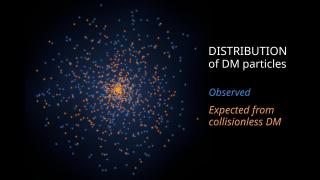
The existence of dark matter is probably one of the fundamental mysteries of modern science and unraveling its nature has become one of the primary goals of modern Physics. Despite representing 85% of all matter in the Universe, we do not know what it is. In its simplest description, it is made up of particles that interact with each other and with ordinary matter only through gravity. However, this description does not correspond to any physical model. Finding out what dark matter is requires finding evidence of some kind of interaction of dark matter that goes beyond gravity. In our work
Advertised on
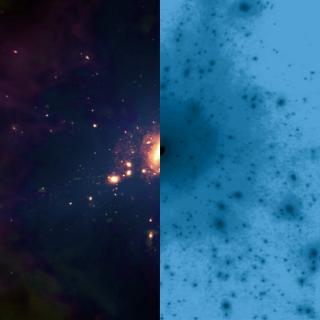
A study led by researcher Laura Scholz, of the Instituto de Astrofísica de Canarias (IAC) has found, for the first time, observational evidence that the evolution and the properties of the galaxies are conditioned not only by the mass of the stars they contain, but aso by the effect of the dark matter halos which surround them. The results are published in the specialist journal Nature Astronomy. Dark matter comprises around 85% of all the matter in the Universe. Although ordinary matter absorbs, reflects and emits light, dark matter cannot be seen directly, which makes its detection
Advertised on