The International Scientific Committee (ISC) of the Canary Islands Observatories held its 96th meeting on 9 and 10 November, during which it discussed the current state of the astronomical facilities managed by the Canary Islands Institute of Astrophysics (IAC), as well as the main measures planned to ensure their long-term operation and sustainability.
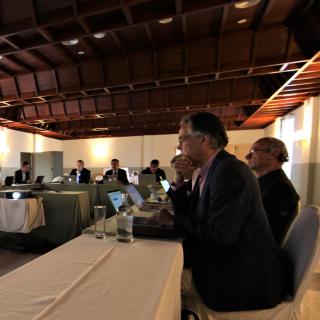
The meeting took place online, although the IAC staff who sit on the Committee attended the sessions in person at the Institute’s headquarters in La Laguna.
The issues discussed included the conditions of access to the observatories and the electricity supply, with particular attention paid to power cuts and possible short- and long-term solutions. Issues relating to the economic and environmental sustainability of the facilities were also addressed, including the development of a comprehensive plan for both observatories covering aspects such as energy, waste management and transport.
In the scientific and operational sphere, the Committee has analysed the International Time Programme (ITP), which allows institutions participating in the International Agreements to access a portion of the telescopes’ observing time, and has reviewed the procedures for monitoring and acknowledging scientific publications arising from this programme. Furthermore, issues relating to the Time Allocation Committee (TAC) and the possible creation of a new working group dedicated to time-domain astronomy—focusing on the study of variable and transient phenomena in the universe—were discussed.
The agenda also included the presentation of the tenth ASTRI telescope, given by Giovanni Pareschi (INAF), and a review of various strategic issues, such as the coordination of a joint response by unique scientific and technical astronomy infrastructures to the impact of SpaceX’s satellite constellations, and the implementation of the Laser Traffic Control System (LTCS), designed to coordinate laser emissions from telescopes and prevent interference with other facilities.
Administration of the Observatories
The report from the Roque de los Muchachos Observatory (ORM) has reviewed the outreach activities carried out up to September 2026, which include visits, participation in the ‘Our Students and the ORM’ programme, and various educational and outreach activities. In terms of management, data on budget implementation and forecasts for 2027 were presented, as well as the financial performance of the Residence, which has been affected by rising service costs. A report was also given on the progress of construction works and new facilities, including the Cherenkov Telescope Array Observatory – North (CTAO-N) and COXMo-2 projects, improvements to access routes and electrical infrastructure, and sustainability and energy efficiency projects. Furthermore, pending actions relating to water supply and sanitation were reviewed.
For its part, the report from the Teide Observatory (OT) addressed the measures set out in its Emergency Plan, particularly the actions to improve safety and control access via the TF-514 road. The report included a presentation of the budget forecast for 2027 and an update on the status of new facilities and projects under construction, such as SELF, STRIP/TMS, COXMo-OT, Speculoos 2 and MONS 2.0, as well as other initiatives currently under evaluation by the Site Properties Sub-Committee (SUCOSIP) or being developed through agreements. Information was also provided on the planned work for the demolition of the Newton telescope and the Savart tower.
Furthermore, the conclusions of the meeting of SUCOSIP – the group of experts that advises the CCI on atmospheric characterisation and the protection of the astronomical quality of the Canary Islands Observatories – have been examined. This technical committee assesses the potential impact of new facilities and activities on observing conditions.
The CCI is the body established under the international agreements that led to the creation of the Canary Islands Observatories, and it ensures the effective participation of user institutions in decisions relating to the use, maintenance and improvement of these scientific infrastructures of international standing. Its regular meetings enable it to coordinate activities, assess needs and set priorities in order to preserve the scientific excellence of the observatories.