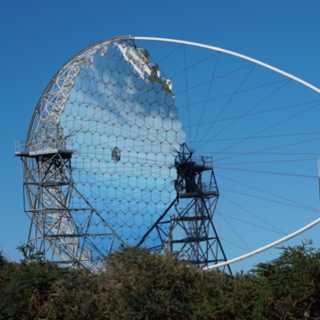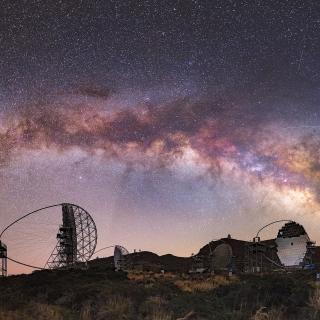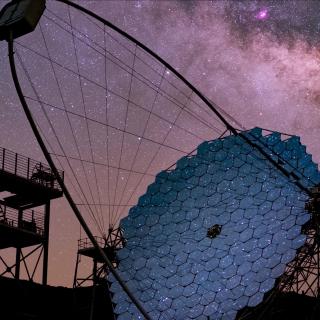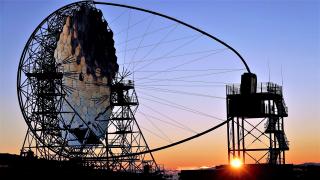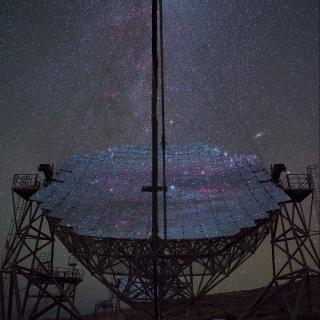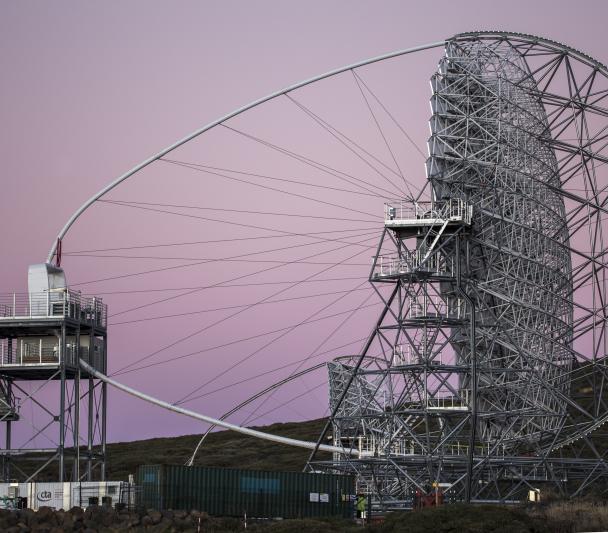

On 11 August, the CTAO LST Collaboration and the MAGIC Collaboration released remarkable findings from observations of OP 313, the most distant very high-energy blazar ever recorded. The paper, published in the journal Astronomy & Astrophysics, presents in-depth observations conducted with the prototype Large-Sized Telescope (LST-1) and the MAGIC telescopes at the Roque de los Muchachos Observatory in La Palma, Spain.
This comprehensive study follows the discovery of the source at very high energies by the LST-1 in December 2023, announced, at that time, via an Astronomer's Telegram (ATel). The joint observations captured a flux of very high-energy photons originating from a distance of roughly eight billion light-years. By analysing these gamma rays, scientists were able to unveil crucial information about the diffuse extragalactic background light (EBL) and decode the complex particle acceleration processes at work within the engine of the distant galaxy.
Blazars are exceptionally bright active galactic nuclei, galaxies powered by a central supermassive black hole. OP 313, in particular, is classified as a flat spectrum radio quasar, a specific kind of blazar that ranks among the most bright and powerful emitters in the Universe. Around 11 billion years ago, the Universe experienced a period of peak activity known as the "Cosmic noon," characterised by an intense rate of star and galaxy formation. As this burst slowed down and galaxies began to mature, the Universe transitioned into a quieter phase, which is still ongoing today. It was during the beginning of this era that OP 313 emitted the powerful flare of very high-energy gamma rays that was detected by the LST-1 and MAGIC telescopes.
As these highly energetic gamma rays travelled across the cosmos for eight billion years, they interacted with the EBL, a persistent field of radiation from all energies emitted by cosmic objects throughout the Universe's history. This interaction attenuates the gamma-ray signal through a process known as “pair production.” When these gamma rays collide with the EBL, their energy transforms into pairs of particles, specifically an electron and a positron. As a result, the original gamma-ray flux of the cosmic source is reduced over the vast distance it travels, making it a challenge to detect. To do so requires exceptionally sensitive instruments.
By analysing the joint dataset from the LST-1 and MAGIC telescopes, alongside lower-energy data from other facilities, the authors of the publication obtained stringent constraints on the EBL density and characterised the flux variability. They determined that the intense gamma-ray emission was driven by a dense population of relativistic electrons. In this so-called "leptonic scenario," electrons were accelerated to near light speed within a massive jet of plasma launched by OP 313's central supermassive black hole. As they collide with lower-energy light surrounding the black hole, the electrons transfer part of their immense energy to the photons, boosting them into very high-energy gamma rays. Ultimately, these findings mark a major step forward in understanding the internal engines of flat spectrum radio quasars.
The LST-1 is the prototype for the Large-Sized Telescopes (LSTs), currently undergoing commissioning at the CTAO-North site in La Palma, Spain. Discovering the most distant very high-energy blazar during this testing phase is clear proof of the telescope's outstanding performance and its promising future. On 15 October this year, the complete LST sub-array, featuring three additional telescopes, will be inaugurated in La Palma by the LST Collaboration. Tasked with driving the CTAO's low-energy sensitivity down to 20 GeV, the LSTs’ future observations will be capable of successfully extending the gamma-ray horizon, allowing researchers to observe extreme radiation at distances never reached before.
"Every new detection of very distant objects, whose light has taken billions of years to reach us, opens a new window for studying the extragalactic background light and understanding how the cosmos has evolved. These observations bring us closer to the era of peak cosmic star formation. With the CTAO set to begin operations in the coming years, this is just the beginning,” explains Mireia Nievas Rosillo, a researcher at the IAC and corresponding author of the study.
The CTAO LST Collaboration is an In-Kind Contributor (IKC) for the CTAO, in charge of building the Large-Sized Telescopes (LSTs). The collaboration is made up of more than 500 scientists and engineers from 25 institutions across 11 countries: Brazil, Bulgaria, Croatia, Czech Republic, France, Germany, Italy, Japan, Poland, Spain and Switzerland.
| The IAC’s activities under the project “The Four Large Size Telescopes (LST) of CTA-Norte at the ORM”, reference ESFRI-2017-01-IAC-12, are funded by the Ministry of Science, Innovation and Universities (MICIU) and 85 per cent co-funded by European Regional Development Fund (ERDF). The activities also receive funding from the Government of the Canary Islands, via the Canary Islands Agency for Research, Innovation and the Information Society (ACIISI), and the Regional Ministry of Universities, Science, Innovation and Culture. |
Article: "Detection of the distant quasar OP 313 with the first Large-Sized Telescope of CTAO", Astronomy & Astrophysics, 2026. DOI: https://doi.org/10.1051/0004-6361/202558646
Contact at the IAC:
Mireia Nievas Rosillo, mireia.nievas [at] iac.es (mireia[dot]nievas[at]iac[dot]es)
Alicia López Oramas, alicia.lopez [at] iac.es (alicia[dot]lopez[at]iac[dot]es)