News

This section includes scientific and technological news from the IAC and its Observatories, as well as press releases on scientific and technological results, astronomical events, educational projects, outreach activities and institutional events.

Displaying 1 - 6 of 2901
Advertised on
  • Workshop on ERC opportunities under Horizon Europe
    On Tuesday, the Instituto de Astrofísica de Canarias (IAC) held a workshop at the Museum of Science and the Cosmos in Tenerife (Spain), focused on promoting successful participation in the European Research Council (ERC) calls for proposals under the European Horizon Europe framework programme, the European Union’s main instrument for funding research and innovation. The event, organised as part of the Alpha Star project, brought together research staff from the IAC and other organisations within the regional R&D ecosystem, technical staff supporting European projects, and external guests
    Advertised on
  • Grupo de integrantes deL 23 congrese de Multidark
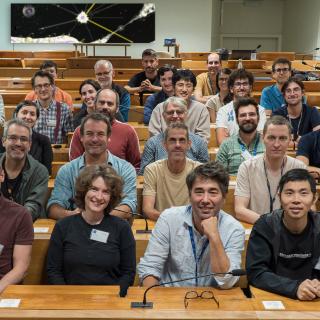
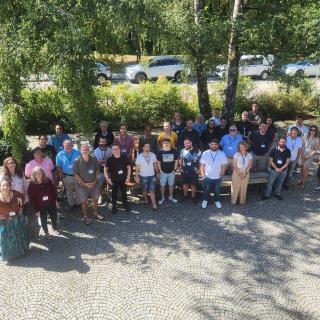
    Durante tres días, especialistas en física de partículas, astrofísica, cosmología, neutrinos, rayos gamma y simulaciones compartieron en Tenerife los últimos avances para descifrar uno de los mayores enigmas del Universo. El Instituto de Astrofísica de Canarias (IAC) acogió la semana pasada, del 17 al 19 de junio, el 23rd MultiDark Meeting, un encuentro científico que reunió a especialistas de distintos centros de investigación españoles para abordar una de las grandes preguntas abiertas de la física contemporánea: ¿de qué está hecha la materia oscura? El congreso fue organizado por la línea
    Advertised on
  • Nucleus od M74
    Nuclear star clusters are dense and compact stellar systems, with sizes of a few parsecs, found at the centers of many galaxies. Their formation is thought to be closely connected to the assembly history of their host galaxies, and astronomers think that these clusters contain important clues about how galaxies formed and evolved over cosmic time. Recent studies suggest that different formation pathways may operate in late- and early-type galaxies, but the dominant mechanisms and their dependence on galaxy morphology remain unclear. While most observational studies have focused on early-type
    Advertised on
  • Cosmolab
    Docentes y estudiantes de Tenerife han participado durante el curso en actividades orientadas al conocimiento de los observatorios de Canarias y de la investigación astrofísica. La iniciativa del Instituto de Astrofísica de Canarias (IAC), desarrollada con el apoyo del Cabildo de Tenerife, ha formado a cerca de un centenar de docentes y ha llegado a más de 3.000 estudiantes. El programa celebrará el próximo 25 de junio una jornada de formación para profesorado centrada en la iniciación a la astrofotografía. La comunidad educativa de Tenerife ha concluido una nueva edición del proyecto “
    Advertised on
  • Savita Mathur, investigadora del Instituto de Astrofísica de Canarias y responsable del proyecto MELODY, reconocido con una ERC Advanced Grant.
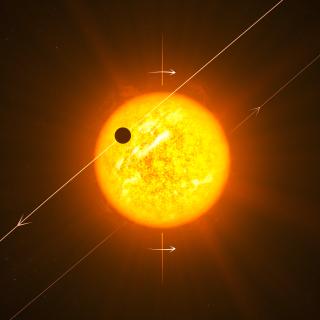
    The Instituto de Astrofísica de Canarias (IAC) has been awarded a new ERC Advanced Grant by the European Research Council (ERC) for the MELODY project, led by researcher Savita Mathur. This grant, one of the most prestigious and competitive in European science, supports established researchers with outstanding track records and highly innovative proposals, with the aim of promoting frontier research capable of opening up new avenues of knowledge. MELODY’s main objective is to study the rotation and magnetic activity of Sun-like stars in order to understand in greater detail the physical
    Advertised on
  • Illustration of the ‘cosmic time capsule’ NGC 1277
    Clues to the first stars may be hiding much closer to home than expected. An international team led by the Instituto de Astrofísica de Canarias (IAC) has detected potential chemical traces of the very first stars in the Universe within a neighboring galaxy. The setting for this discovery is NGC 1277, a well-known "relic" galaxy. While normal galaxies grow and transform by merging with others throughout their history, this compact system formed most of its stars very quickly in the early Universe and became frozen in time. Acting as a cosmic time capsule, this galaxy is perfect for
    Advertised on