News

This section includes scientific and technological news from the IAC and its Observatories, as well as press releases on scientific and technological results, astronomical events, educational projects, outreach activities and institutional events.

Displaying 1009 - 1014 of 2908
Advertised on
  • Amanar: under the same sky
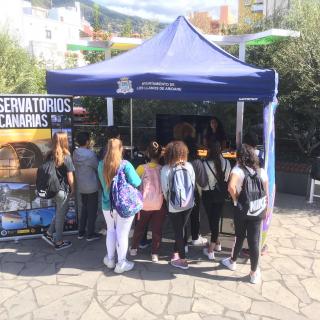
    Today marks the official start of this outreach project in astronomy, which promotes scientific education and supports the young people and the teachers who live in the saharaui refugee camps. The activities of astronomical popularization and the visits to the Canary Observatories will start on July 20th, and will last until October, when an international team, with participation from the Instituto de Astrofísica de Canarias (IAC) will travel to the saharaui refugee camps near Tinduf, in Algeria. Amanar, which means The Pleiades” in Berber, is an astronomical outreach project to inspire the
    Advertised on
  • Image of the opening of the IAU Symposium 355
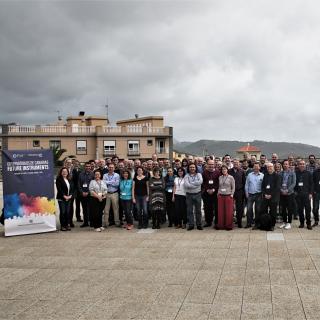
    In the University of La Laguna today the conference of the International Astronomical Union about the diffuse light in the sky, organized by the Instituto de Astrofísica de Canarias was inaugurated. This meeting brings together over a hundred astronomers in a variety of fields from over 20 countries.
    Advertised on
  • The anti-correlation between the amount of metals and the star formation rate when comparing galaxies with similar stellar mass. Galaxies with more (lower image) and less (upper image) star-forming regions (the blue clumps) are shown.
    The so-called "fundamental metallicity relation" (FMR) has been known for almost 10 years, and it states that galaxies of the same stellar mass but larger star formation rate have more chemically primitive gas. It is thought to be fundamental because it naturally arises from the stochastic feeding of star-formation from external metal-poor gas accretion, a process extremely elusive to observe but essential according the cosmological simulations of galaxy formation. Galaxies transform gas into stars at a rate that quickly exhaust their gas reservoir. Therefore, a continuous supply of external
    Advertised on
  • Line profiles showing the blueshifted broad components of the ionized/molecular outflow. Fits to the broad (blue), narrow (red), continuum (orange), and total (green) components are shown (shaded areas were used in the determination of the outflow sizes).
    The supermassive black holes in the centres of galaxies have a basic influence on their evolution. This happens during a phase in which the black hole is consuming the material of the galaxy in which it resides at a very high rate, growing in mass as it does so. During this phase we say that the galaxy has an active nucleus (AGN, for active galactic nucleus). The effect that this activity has on the host galaxy is known as AGN feedback, and one of its forms are galactic winds: gas from the centre of the galaxy being driven out by the energy released by the active nucleus. These winds can
    Advertised on
  • Ocean of Stars: The faint, glowing clouds spread across this image are galactic cirrus: clouds of interstellar gas and dust that can be seen in the foreground of the Milky Way
    The Vera C. Rubin Observatory launches an ambitious ten-year study set to transform astronomical research The Vera C. Rubin Observatory, based in Chile, has officially launched the Legacy Survey of Space and Time (LSST), a ten-year observational programme that will produce the most comprehensive and detailed survey of the southern sky to date. Jointly funded by the US National Science Foundation (NSF) and the US Department of Energy (DOE), the Canary Islands Institute of Astrophysics (IAC) is participating in this international initiative through the Spanish consortium, which will contribute
    Advertised on