Bibcode
De Jonghe, Jordi; Sen, Samrat
Bibliographical reference
Monthly Notices of the Royal Astronomical Society
Advertised on:
2
2025
Citations
6
Refereed citations
6
Description
In the solar corona, magnetically sheared structures are unstable to both tearing and thermal instabilities in a coupled fashion. However, how the choice of linear perturbation modes influences the time-scale to achieve the thermal runaway in a coupled tearing-thermal coronal current sheet is not well understood to date. Here, we model a force-free Harris current sheet under solar coronal conditions to investigate this coupling in the linear and non-linear regimes. In the linear regime, we adopt the magnetohydrodynamic spectroscopy code LEGOLAS to compare the current sheet under thermal and thermoresistive conditions, after which we initialize non-linear simulations (with MPI-AMRVAC) with the unstable, linear tearing and thermal perturbations obtained with LEGOLAS. It is shown that part of the unstable thermal quasi-continuum adopts tearing properties in the linear stage, but that it is not until the non-linear stage is reached that a true thermal 'runaway' effect leads to condensations inside tearing-induced flux ropes. Hence, the linear stage is governed by the dominant tearing instability whilst condensations form due to tearing-thermal coupling in the non-linear stage. Our results imply that perturbing an equilibrium current sheet with the fastest growing linear mode skips the mode-mixing phase in which the dominant instability traditionally emerges, and significantly reduces the time-scale to enter into the non-linear stage and thermal runaway process from its equilibrium configuration.
Related projects
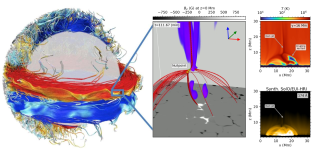
The Whole Sun Project: Untangling the complex physical mechanisms behind our eruptive star and its twins
The Sun is a magnetically active star with violent eruptions that can hit Earth´s magnetosphere and cause important perturbations in our technology-dependent society. The objective of the Whole Sun project is to tackle in a coherent way for the first time key questions in Solar Physics that involve as a whole the solar interior and the atmosphere
Fernando
Moreno Insertis
Numerical Simulation of Astrophysical Processes
Numerical simulation through complex computer codes has been a fundamental tool in physics and technology research for decades. The rapid growth of computing capabilities, coupled with significant advances in numerical mathematics, has made this branch of research accessible to medium-sized research centers, bridging the gap between theoretical and