
Bibcode
Suzuki, Hiromasa; Tsuji, Naomi; Kanemaru, Yoshiaki; Shidatsu, Megumi; Olivera-Nieto, Laura; Safi-Harb, Samar; Kimura, Shigeo S.; de la Fuente, Eduardo; Casanova, Sabrina; Mori, Kaya; Wang, Xiaojie; Kato, Sei; Tateishi, Dai; Uchiyama, Hideki; Tanaka, Takaaki; Uchida, Hiroyuki; Inoue, Shun; Huang, Dezhi; Lemoine-Goumard, Marianne; Miura, Daiki; Ogawa, Shoji; Kobayashi, Shogo B.; Done, Chris; Parra, Maxime; Díaz Trigo, Maria; Muñoz-Darias, Teo; Armas Padilla, Montserrat; Tomaru, Ryota; Ueda, Yoshihiro
Bibliographical reference
The Astrophysical Journal
Advertised on:
1
2025
Journal
Citations
19
Refereed citations
18
Description
A recent report on the detection of very-high-energy gamma rays from V4641 Sagittarii (V4641 Sgr) up to ≈0.8 PeV has made it the second confirmed "PeVatron" microquasar. Here we report on the observation of V4641 Sgr with X-Ray Imaging and Spectroscopy Mission (XRISM) in 2024 September. Thanks to the large field of view and low background, the CCD imager Xtend successfully detected for the first time X-ray extended emission around V4641 Sgr with a significance of ≳4.5σ and >10σ based on our imaging and spectral analysis, respectively. The spatial extent is estimated to have a radius of 7' ± 3' (13 ± 5 pc at a distance of 6.2 kpc) assuming a Gaussian-like radial distribution, which suggests that the particle acceleration site is within ~10 pc of the microquasar. If the X-ray morphology traces the diffusion of accelerated electrons, this spatial extent can be explained by either an enhanced magnetic field (∼80 μG) or a suppressed diffusion coefficient (∼1027 cm2 s‑1 at 100 TeV). The integrated X-ray flux, (4–6) × 10‑12 erg s‑1 cm‑2 (2–10 keV), would require a magnetic field strength higher than the Galactic mean (≳8 μG) if the diffuse X-ray emission originates from synchrotron radiation and the gamma-ray emission is predominantly hadronic. If the X-rays are of thermal origin, the measured extension, temperature, and plasma density can be explained by a jet with a luminosity of ∼2 × 1039 erg s‑1, which is comparable to the Eddington luminosity of this system.
Related projects
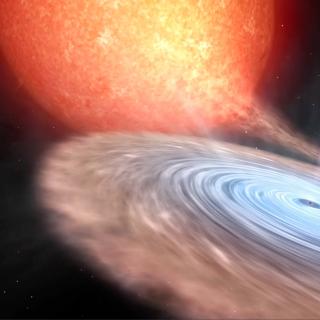
Black holes, neutron stars, white dwarfs and their local environment
Accreting black-holes and neutron stars in X-ray binaries provide an ideal laboratory for exploring the physics of compact objects, yielding not only confirmation of the existence of stellar mass black holes via dynamical mass measurements, but also the best opportunity for probing high-gravity environments and the physics of accretion; the most
Montserrat
Armas Padilla