
Bibcode
Abe, K.; Abe, S.; Abhishek, A.; Acero, F.; Aguasca-Cabot, A.; Agudo, I.; Alispach, C.; Alvarez Crespo, N.; Ambrosino, D.; Antonelli, L. A.; Aramo, C.; Arbet-Engels, A.; Arcaro, C.; Asano, K.; Aubert, P.; Baktash, A.; Balbo, M.; Bamba, A.; Baquero Larriva, A.; Barres de Almeida, U.; Barrio, J. A.; Barrios Jiménez, L.; Batkovic, I.; Baxter, J.; Becerra González, J.; Bernardini, E.; Bernete, J.; Berti, A.; Bezshyiko, I.; Bhattacharjee, P.; Bigongiari, C.; Bissaldi, E.; Blanch, O.; Bonnoli, G.; Bordas, P.; Borkowski, G.; Brunelli, G.; Bulgarelli, A.; Bunse, M.; Burelli, I.; Burmistrov, L.; Buscemi, M.; Cardillo, M.; Caroff, S.; Carosi, A.; Carrasco, M. S.; Cassol, F.; Castrejón, N.; Cerasole, D.; Ceribella, G.; Chai, Y.; Cheng, K.; Chiavassa, A.; Chikawa, M.; Chon, G.; Chytka, L.; Cicciari, G. M.; Cifuentes, A.; Contreras, J. L.; Cortina, J.; Costantini, H.; Da Vela, P.; Dalchenko, M.; Dazzi, F.; De Angelis, A.; de Bony de Lavergne, M.; De Lotto, B.; de Menezes, R.; Del Burgo, R.; Del Peral, L.; Delgado, C.; Delgado Mengual, J.; della Volpe, D.; Dellaiera, M.; Di Piano, A.; Di Pierro, F.; Di Tria, R.; Di Venere, L.; Díaz, C.; Dominik, R. M.; Dominis Prester, D.; Donini, A.; Dore, D.; Dorner, D.; Doro, M.; Eisenberger, L.; Elsässer, D.; Emery, G.; Escudero, J.; Fallah Ramazani, V.; Ferrarotto, F.; Fiasson, A.; Foffano, L.; Freixas Coromina, L.; Fröse, S.; Fukazawa, Y.; Garcia López, R.; Gasbarra, C.; Gasparrini, D.; Geyer, D. et al.
Bibliographical reference
Astronomy and Astrophysics
Advertised on:
3
2025
Journal
Citations
16
Refereed citations
12
Description
Context. The recurrent nova RS Ophiuchi (RS Oph) underwent a thermonuclear eruption in August 2021. In this event, RS Oph was detected by the High Energy Stereoscopic System (H.E.S.S.), the Major Atmospheric Gamma Imaging Cherenkov (MAGIC), and the first Large-Sized Telescope (LST-1) of the future Cherenkov Telescope Array Observatory (CTAO) at very-high gamma-ray energies above 100 GeV. This means that novae are a new class of very-high-energy (VHE) gamma-ray emitters. Aims. We report the analysis of the RS Oph observations with LST-1. We constrain the particle population that causes the observed emission in hadronic and leptonic scenarios. Additionally, we study the prospects of detecting further novae using LST-1 and the upcoming LST array of CTAO-North. Methods. We conducted target-of-opportunity observations with LST-1 from the first day of this nova event. The data were analysed in the framework of cta-lstchain and Gammapy, the official CTAO-LST reconstruction and analysis packages. One-zone hadronic and leptonic models were considered to model the gamma-ray emission of RS Oph using the spectral information from Fermi-LAT and LST-1, together with public data from the MAGIC and H.E.S.S. telescopes. Results. RS Oph was detected at 6.6σ with LST-1 in the first 6.35 hours of observations following the eruption. The hadronic scenario is preferred over the leptonic scenario considering a proton energy spectrum with a power-law model with an exponential cutoff whose position increases from (0.26 ± 0.08) TeV on day 1 up to (1.6 ± 0.6) TeV on day 4 after the eruption. The deep sensitivity and low energy threshold of the LST-1/LST array will allow us to detect faint novae and increase their discovery rate.
Related projects
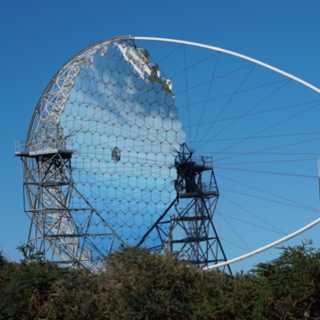
Particle Astrophysics
The members of the Particle Astrophysics Group of the IAC participate actively in three large international collaborations of high-energy astrophysics: AMS-02 (Alpha Magnetic Spectrometer), the Cherenkov radiation telescopes MAGIC I and II and the Cherenkov Telescope Array Observatory ( CTAO). We also participate in the ASTRI mini-array, the gamma
Mónica Luisa
Vázquez Acosta