
Bibcode
Rout, Sandeep K.; Baglio, M. Cristina; Hughes, Andrew K.; Russell, David M.; Bramich, D. M.; Saikia, Payaswini; Alabarta, Kevin; Armas Padilla, Montserrat; Campana, Sergio; Covino, Stefano; D'Avanzo, Paolo; Fender, Rob; Goldoni, Paolo; Homan, Jeroen; Lewis, Fraser; Masetti, Nicola; Motta, Sara; Muñoz-Darias, Teo; Papitto, Alessandro; Russell, Thomas D.; Sivakoff, Gregory; van den Eijnden, Jakob
Bibliographical reference
The Astrophysical Journal
Advertised on:
8
2025
Journal
Citations
5
Refereed citations
4
Description
Several phenomenological aspects of low-luminosity neutron star transients, such as atolls, remain poorly understood. One such source, MAXI J1807+132, entered its latest outburst in 2023 July. To thoroughly characterize this outburst, we conducted an extensive observational campaign spanning radio to X-ray wavelengths. Here we present the results of this campaign, which covered the period from before the outburst to the return to quiescence. We detected a delay between the X-ray and optical rise times, which is consistent with the predictions of the disk instability model with a truncated disk. The color evolution and optical/X-ray correlations, along with infrared and radio detections, support the presence of jet synchrotron emission during the gradual decay phase following the peak. We also report for the first time in an X-ray binary a near-orthogonal rotation of the optical polarization just before a small flare, after which the jet is thought to be quenched. The main outburst is followed by several high-amplitude, rapid reflares in the optical, ultraviolet, and X-ray bands, the origin of which remains difficult to constrain.
Related projects
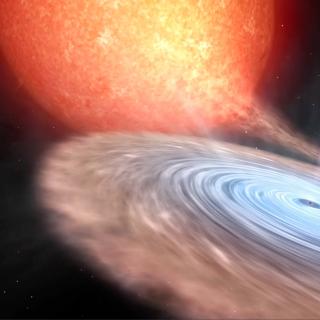
Black holes, neutron stars, white dwarfs and their local environment
Accreting black-holes and neutron stars in X-ray binaries provide an ideal laboratory for exploring the physics of compact objects, yielding not only confirmation of the existence of stellar mass black holes via dynamical mass measurements, but also the best opportunity for probing high-gravity environments and the physics of accretion; the most
Montserrat
Armas Padilla