
Bibcode
Rodríguez-Martín, J. E.; Díaz-García, L. A.; González Delgado, R. M.; Martínez-Solaeche, G.; García-Benito, R.; de Amorim, A.; Thainá-Batista, J.; Cid Fernandes, R.; Márquez, I.; Fernández-Soto, A.; Breda, I.; Abramo, R.; Alcaniz, J.; Benítez, N.; Bonoli, S.; Carneiro, S.; Cenarro, A. J.; Cristóbal-Hornillos, D.; Dupke, R. A.; Ederoclite, A.; Hernán-Caballero, A.; Hernández-Monteagudo, C.; López-Sanjuan, C.; Marín-Franch, A.; Mendes de Oliveira, C.; Moles, M.; Sodré, L.; Taylor, K.; Varela, J.; Ramió, H. Vázquez
Bibliographical reference
Astronomy and Astrophysics
Advertised on:
12
2025
Journal
Citations
3
Refereed citations
2
Description
This work presents Py2DJPAS, a tool developed in Python to automate the analysis of the properties of spatially resolved galaxies in the miniJPAS survey, a 1 deg2 survey that acts as precursor of the Javalambre Physics of the Acclerating Universe Survey (J-PAS), using the same filter system and telescope and the J-PAS Pathfinder camera. Our goal is to provide a single code to download the scientific images and tables required for analysis, perform point spread function (PSF) homogenization, automate masking, define apertures, and run an external fitting code for spectral energy distribution (SED) analysis as well as to estimate the equivalent widths of the main optical emission lines via an artificial neural network. We selected a sample of spatially resolved galaxies in miniJPAS and calculated their magnitudes in all bands to demonstrate that we retrieve the same values as those provided in the miniJPAS catalogue using SExtractor with a precision of approximately 10%. We show that these measurements are significantly improved by the local estimation of the background for dimmer galaxies and apertures. The PSF homogenization enhances multi-band photometry in the innermost apertures, ensuring consistent apertures across filters that permit the generation of pseudo-spectra without undesired artefacts or variations due to mismatched photometry. By performing a SED fitting of the multi-band photometry (J-spectra) within annular apertures over the PSF-homogenized images, we found that the residuals of the fitting remain below ∼10%, with no significant wavelength-dependent bias for apertures with S/N>5. Thus, our method provides robust photometric measurements, marking the first step towards our goal of studying the spatially resolved properties of galaxies. Furthermore, we demonstrate the IFU-like capabilities of J-PAS by analysing the spatially resolved properties of the galaxy 2470─10239 at z=0.078 and comparing them with MaNGA data up to 1 half light radius (HLR), which is the maximum extent for this galaxy in the MaNGA data cube. We find very good agreement between the photometric and spectroscopic measurements as well as identical radial profiles of the stellar mass surface density up to 1 HLR. Our analysis extends further to 4 HLR, where the miniJPAS data have S/N ∼5. This provides evidence of the capability of J-PAS to extend the IFU-like analysis to the outskirts of the galaxy, enabling the study of the processes that drive their evolution at larger galactocentric distances.
Related projects
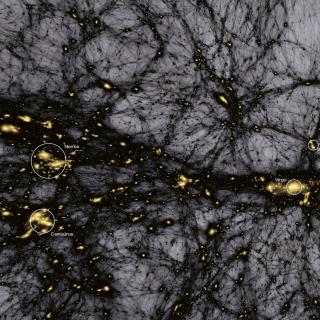
Cosmology with Large Scale Structure Probes
The Cosmic Microwave Background (CMB) contains the statistical information about the early seeds of the structure formation in our Universe. Its natural counterpart in the local universe is the distribution of galaxies that arises as a result of gravitational growth of those primordial and small density fluctuations. The characterization of the
Francisco Shu
Kitaura Joyanes