Related grants:
General
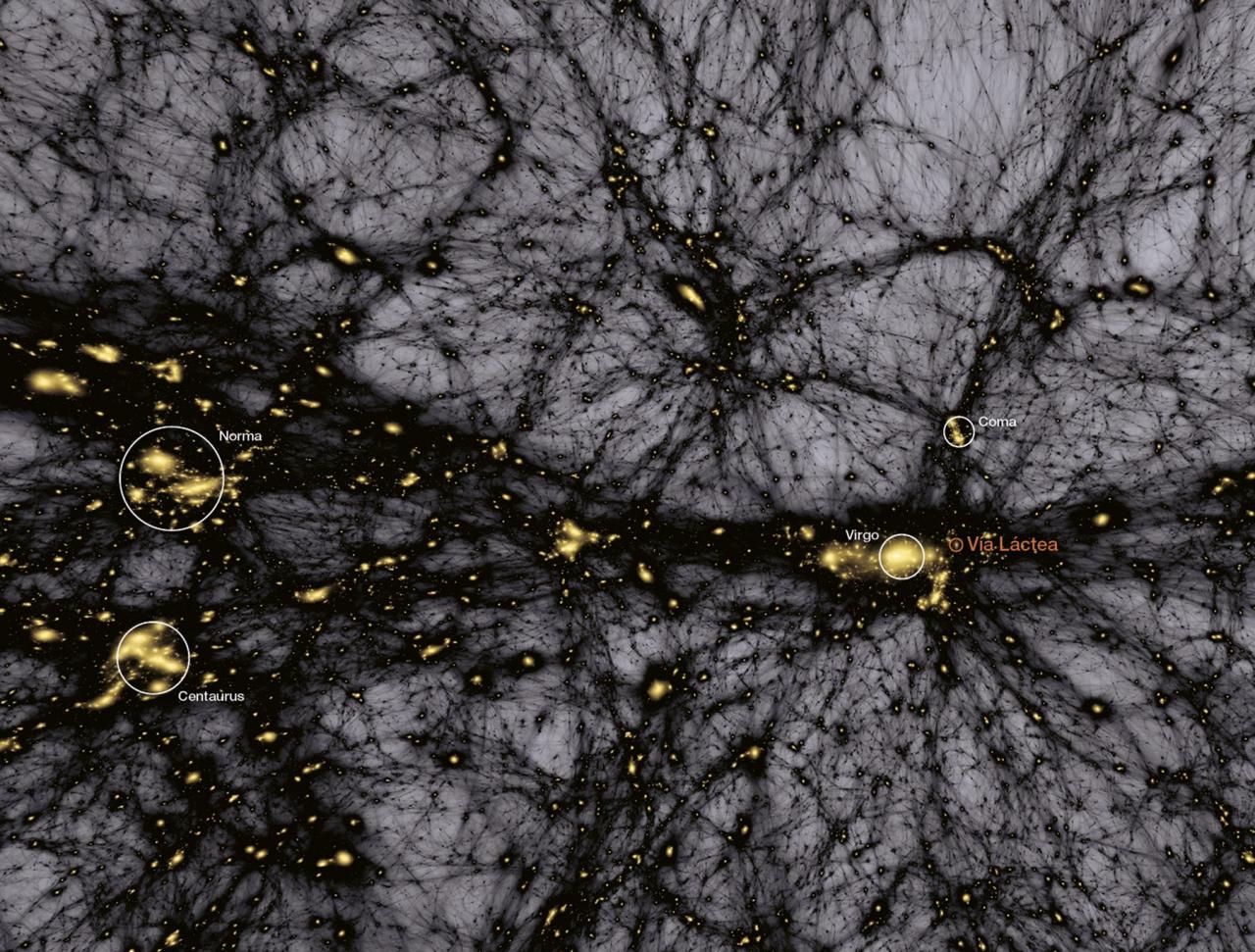
The Cosmic Microwave Background (CMB) contains the statistical information about the early seeds of the structure formation in our Universe. Its natural counterpart in the local universe is the distribution of galaxies that arises as a result of gravitational growth of those primordial and small density fluctuations. The characterization of the distribution of inhomogeneities at large-scale in the local Universe provides a powerful tool, complementary to the CMB, to determine the origin and the energy content of the Universe, the expansion rate of the Universe during the cosmic history, and the detailed process of formation of the large-scale structures (LSS). The study of the LSS in the coming years will attempt to address the following open questions in cosmology:
What is the dark matter, and which is its detailed contribution to the energy content of the Universe?
What is the dark energy, and how it affects the dynamics of the Universe?
What is the connection between large scale structure and galaxy formation?
Do fundamental constants vary along the history of the Universe?
Is there evidence for primordial non-Gaussianities giving information on the details of the inflationary expansion epoch of the Universe?
In order to contribute to the possible answer to those questions, in this project we will use several large scale structure probes:
The distribution and large-scale clustering of the galaxies, and its evolution with time. The matter power spectrum (P(k)) and the two-point correlation function (ξ(r)) contain certain geometric features associated to some characteristic length-scales in the Universe, as the horizon at matter-radiation equality, or the acoustic horizon at last scattering. In particular, the latter determines the Baryon Acoustic Oscillation (BAO) scale.
The higher order statistics: the three-point statistics characterizes the deviation from Gaussinity and therefore the structure formation through gravitational instability, the galaxy bias, and the primordial non-Gaussianities.
The distribution of the cosmic voids in the Universe. Both the statistics of big voids, as well as the characterization of the void expansion, provides a complementary tool to determine the matter density and the equation of state of the dark energy. Cosmic voids contain information of the higher order statistics of galaxies and can be used to further constrain the BAO scale.
The cosmic web can be used to characterize the formation of structures and relate the large scale structure with galaxy formation processes.
The distribution and abundance of galaxy clusters, as well as the evolution with time. Among other parameters, the cluster mass function depends both on the matter density as well as in the amplitude of the power spectrum. The time evolution of the mass function n(M,z) is also govern by the growth of structures in the Universe, thus being also sensitive to the equation of state of the dark energy.
Members
Results
- eBOSS: cosmological analysis from the quasar sample. Marcos Pellejero Ibañez and F. S. Kitaura participated in the construction of the likelihood and the cosmological parameter estimation (including as coauthors Kitaura & Pellejero Ibañez: 2018MNRAS.473.4773A).
- EUCLID: comparison project of mock galaxy catalogue generating codes showing the accuracy and speed of the PATCHY code (including as coauthors Balaguera-Antolínez, Kitaura & Pellejero Ibañez:https://arxiv.org/abs/1806.09497, https://arxiv.org/abs/1806.09477, https://arxiv.org/abs/1806.09499)
- Development of an accurate Bias mapping method for large scale structure analysis (Balaguera-Antolínez, Kitaura, Pellejero Ibañez et al 2018:https://arxiv.org/abs/1806.05870)
- Presentation of the UNITSIM project to provide simulations for the theoretical model comparison for DESI and EUCLID (including as coauthors Kitaura & Pellejero Ibañez:http://www.unitsims.org/ https://arxiv.org/abs/1811.02111)
- Presentation of BARCODE (Bos, Kitaura & Weygaert 2018: https://arxiv.org/abs/1810.05189, http://adsabs.harvard.edu/abs/2018ascl.soft10002B)
Scientific activity
Related publications
Related conferences
-
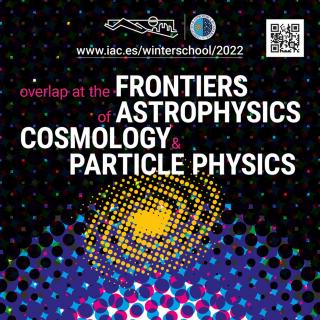 XXXIII Canary Islands Winter School of Astrophysics: Astroparticle Physics and CosmologyThe XXXIII Canary Islands Winter School of Astrophysics, organized by the Instituto de Astrofísica de Canarias (IAC), focuses on Astroparticle Physics and Cosmology. The school, to be held in San"Salón de actos" at the Museo de la Ciencia y el Cosmos (MCC) Avda. Los Menceyes 70 38205 San Cristóbal de La LagunaSpainDate-Past