Actividad Nuclear en Galaxias: una Perspectiva 3D del Núcleo y su Entorno

    General
    Descripción

    Nuestro grupo se divide en dos líneas principales de investigación. En primer lugar, el estudio de los vientos producidos por cuásares luminosos oscurecidos y del impacto que estos tienen en sus galaxias anfitrionas (retroalimentación del AGN). Como parte de este proyecto, denominado QSOFEED (Quasar Feedback) hemos obtenido observaciones infrarrojas y ópticas con los instrumentos del Gran Telescopio CANARIAS (GTC) CanariCam, EMIR y MEGARA, datos en el infrarrojo medio con el James Webb Space Telescope, en el rango milimétrico con ALMA y en radio con VLA. Parte de esta investigación la hemos realizado en el marco de la Innovative Training Network BID4BESt, del programa H2020, y desde 2024 con la Twinning action ExGal-Twin. Nuestro grupo está también fuertemente involucrado en la colaboración internacional GATOS (Galactic Activity, Torus and Outflow Survey), creada con el objetivo de caracterizar la cinemática del gas y el material que oscurece el núcleo de galaxias activas cercanas haciendo uso de datos de ALMA y del JWST. En segundo lugar, nuestra actividad se centra en la aplicación de la espectroscopia de campo integral al estudio de objetos extensos tales como galaxias con formación estelar o galaxias activas para investigar el encendido de ambos fenómenos. Asimismo, contribuimos al desarrollo de nuevos instrumentos y técnicas de análisis de datos relacionadas con la espectroscopia 3D. En particular, participamos en el desarrollo del espectrógrafo de campo integral de alta resolución HARMONI, uno de los instrumentos de primera generación del Extremely Large Telescope de la ESO.

    Investigador principal
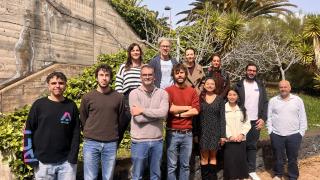
    Personal del proyecto
    1. La financiación externa conseguida desde 2020 por C. Ramos Almeida y B. García Lorenzo en el marco de este proyecto asciende a 2.370.500 euros. En 2025 se incorporó al grupo la investigadora Juan de La Cierva Marina Bianchin.
    2. Se ha continuado publicando trabajos basados en datos del proyecto QSOFEED, cuyo objetivo es cuantificar el impacto de la retroalimentación del AGN en las galaxias anfitrionas (Audibert et al. 2025; Holden et al. 2025; Ramos Almeida et el 2025; Zanchettin et al. 2025).
    3. En el marco del proyecto QSOFEED se consiguió tiempo con ALMA en el ciclo 12, con VLA y con GTC/MEGARA (PI: A. Audibert). También se ha conseguido tiempo con JWST como parte del consorcio GATOS en el ciclo 4 (propuestas 7195, 7429 y 7802).
    4. Como parte de la colaboración GATOS, se han publicado diez trabajos en los que han participado entre uno y tres miembros de este proyecto. La reunión anual de GATOS se celebró en la sede del IAC en mayo de 2025.
    5. Se ha consolidado la colaboración con el grupo de AGN del Kavli Institute for Cosmology de la Universidad de Cambridge a través de los artículos Ramos Almeida et al. 2025 y Ji et al. 2026 y de propuestas de tiempo con GTC y VLT.
    6. Se completó la revisión del alcance del proyecto, tras la cual el STC de ESO confirmó un apoyo unánime y muy positivo al nuevo HARMONI, habilitando el avance hacia la finalización de su diseño técnico. Además, este año A. de Lorenzo- Cáceres se incorporó al PMO de HARMONI como Deputy Project Scientist.


    Publicaciones relacionadas

    A 20 kiloparsec bipolar Lyman α outflow from a radio galaxy at z = 2.95 2024A&A...686A.220C
    Ionised AGN outflows in the Goldfish galaxy: The illuminating and interacting red quasar eFEDSJ091157.4+014327 at z ∼ 0.6 2024A&A...687A.111M
    Scrutinizing evidence for the triggering of active galactic nuclei in the outskirts of massive galaxy clusters at z ≈ 1 2024MNRAS.532..336M
    Integral field spectroscopy supports atmospheric optics to reveal the finite outer scale of the turbulence 2024A&A...687A..40G
    MUSE view of PDS 456: Kiloparsec-scale wind, extended ionized gas, and close environment 2024A&A...686A.250T
    Impacts of Bar-driven Shear and Shocks on Star Formation 2024ApJ...968...87K
    AGN feedback in the Local Universe: Multiphase outflow of the Seyfert galaxy NGC 5506 2024A&A...686A..46E
    Towards an observationally motivated AGN dusty torus model - I. Dust chemical composition from the modelling of Spitzer spectra 2024MNRAS.531.1841R
    A Catalogue and analysis of ultra-diffuse galaxy spectroscopic properties 2024MNRAS.531.1856G
    Observational constraints on the stellar recycled gas in active galactic nuclei feeding 2024MNRAS.531..554R
    Observational Tests of Active Galactic Nuclei Feedback: An Overview of Approaches and Interpretation 2024Galax..12...17H
    ALMA reveals a compact and massive molecular outflow driven by the young AGN in a nearby ULIRG 2024MNRAS.530..446H
    The universal variability of the stellar initial mass function probed by the TIMER survey 2024A&A...684A.110M
    Probing the roles of orientation and multiscale gas distributions in shaping the obscuration of active galactic nuclei through cosmic time 2024MNRAS.52710878A
    The dynamical state of bars in cluster dwarf galaxies: the cases of NGC 4483 and NGC 4516 2024MNRAS.52711218C
    A post-merger enhancement only in star-forming Type 2 Seyfert galaxies: the deep learning view 2024MNRAS.528.6915A
    Deconvolution of JWST/MIRI Images: Applications to an Active Galactic Nucleus Model and GATOS Observations of NGC 5728 2024AJ....167...96L
    Multiphase characterization of AGN winds in five local type-2 quasars 2024A&A...681A..63S
    A new tidal scenario for double bar formation 2024MNRAS.528L..83S
    Obscuration beyond the nucleus: infrared quasars can be buried in extreme compact starbursts 2024MNRAS.527L.144A
    The Galaxy Activity, Torus, and Outflow Survey (GATOS). III. Revealing the inner icy structure in local active galactic nuclei 2024A&A...681L...7G
    Smooth kinematic and metallicity gradients reveal that the Milky Way's nuclear star cluster and disc might be part of the same structure 2023A&A...680A..75N
    Investigating the impact of quasar-driven outflows on galaxies at z ∼ 0.3-0.4 2023A&A...680A..71H
    An Extended Lyα Outflow from a Radio Galaxy at z = 3.7? 2023ApJ...958L..36C
    A plausible link between dynamically unsettled molecular gas and the radio jet in NGC 6328 2023A&A...679A.115P
    A new discovery space opened by eROSITA. Ionised AGN outflows from X-ray selected samples 2023A&A...679A..84M
    Composite Bulges. III. A Study of Nuclear Star Clusters in Nearby Spiral Galaxies 2023ApJ...958..100A
    Disc galaxies are still settling. Discovery of the smallest nuclear discs and their young stellar bars 2023A&A...678A.202D
    Complex AGN feedback in the Teacup galaxy. A powerful ionised galactic outflow, jet-ISM interaction, and evidence for AGN-triggered star formation in a giant bubble 2023A&A...678A.127V
    Testing Physical Scenarios for the Reflection Features of Type-1 AGNs using XMM-Newton and NuSTAR Simultaneous Observations 2023ApJ...954...96V
    Disk Galaxies Are Self-similar: The Universality of the H I-to-Halo Mass Ratio for Isolated Disks 2023ApJ...952L..41K
    The role of grain size in active galactic nuclei torus dust models 2023A&A...676A..73G
    Mapping the stellar population and gas excitation of MaNGA galaxies with MEGACUBES. Results for AGN versus control sample 2023MNRAS.524.5640R
    AGN feedback in action in the molecular gas ring of the Seyfert galaxy NGC 7172 2023A&A...675A..88A
    A radio-jet-driven outflow in the Seyfert 2 galaxy NGC 2110? 2023A&A...675A..58P
    Spatially resolved chemodynamics of the starburst dwarf galaxy CGCG 007-025: evidence for recent accretion of metal-poor gas 2023MNRAS.522.2089D
    Galaxy interactions are the dominant trigger for local type 2 quasars 2023MNRAS.522.1736P
    The miniJPAS survey: AGN and host galaxy coevolution of X-ray-selected sources 2023A&A...672A.137L
    Jet-induced molecular gas excitation and turbulence in the Teacup 2023A&A...671L..12A
    The AGNIFS survey: spatially resolved observations of hot molecular and ionized outflows in nearby active galaxies 2023MNRAS.521.1832R