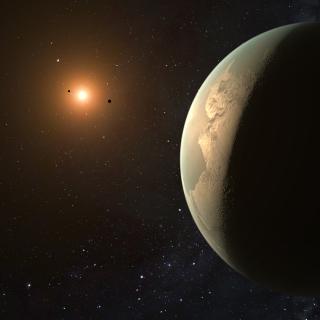
Artistic illustration of the Welopōʻai triple-star system, located just 28 light-years from Earth. The system consists of a red dwarf star (right) and a closely orbiting white dwarf (left), with a second white dwarf (upper) orbiting the pair at a much greater distance. Welopōʻai is the closest known triple-star system containing two white dwarfs. Note: this illustration is not to scale. Image Credit: Benoît Gougeon, Université de Montréal (UdeM).
An international team, including staff from the Canary Islands Institute of Astrophysics (IAC), has discovered a nearby stellar system that challenges our understanding of how stars live, die, and interact with one another. Located just 28 light-years from Earth, the newly characterized system contains three stars, including two white dwarfs - the dense stellar remnants left behind when Sun-like stars exhaust their fuel.
The system, named Welopōʻai, is now the closest known triple-star system containing multiple white dwarfs and one of the most intriguing stellar laboratories in our cosmic neighborhood. The discovery was made by an international team of researchers led by scientists at the Trottier Institute for Research on Exoplanets (IREx) at the Université de Montréal. “We were actually looking for planets," says Étienne Artigau, a researcher at IREx and lead author of the study published in the journal Astronomy and Astrophysics. "Instead, we found something much more surprising."
A Surprise Hidden in Planet-Hunting Data
The discovery was made using SPIRou, a high-precision instrument mounted on the CFHT telescope on Mauna Kea, Hawaii. SPIRou is designed to detect exoplanets by measuring minute changes in a star's motion caused by an orbiting planet. However, scientists found that a nearby red dwarf star exhibited different behavior. "I was invited to join the study because of my experience in the field of planet detection. It began as a completely routine search for planets around the red dwarf," explains Atanas Stefanov, who recently earned his doctorate at the IAC and is a co-author of the study. "Planets are much lighter than their host stars and exert only a subtle gravitational influence on them. Typically, we measure fluctuations in a star's velocity of just a few meters per second. In this case, however, we detected a shift of nearly 16 kilometers per second. That was when we realized that what we had encountered was not an ordinary planet, but a much more massive companion." The team subsequently determined that this hidden companion has a mass greater than half that of our Sun.
Gemini Telescope Reveals the Hidden Star
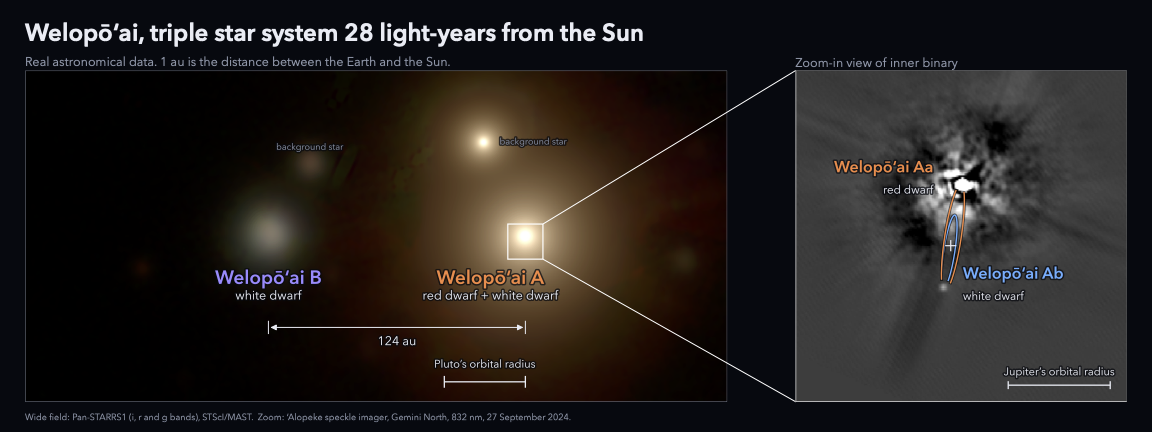
To solve the mystery, the team turned to the Gemini North telescope, also located on Mauna Kea. Using Gemini's ‘Alopeke instument and its powerful high-resolution imaging capabilities, astronomers directly detected the faint companion orbiting the red dwarf. The object proved to be a white dwarf. But the newly discovered white dwarf was not alone. The system was already known to contain a second white dwarf located much farther away. Together, the three stars form a rare triple system: a red dwarf and white dwarf orbit one another closely, while a second white dwarf circles the pair from a much greater distance. No comparable system is known within 100 light-years of Earth.
A System That Shouldn't Exist
Perhaps the most fascinating aspect of Welopō’ai is its complicated evolutionary history. Astronomers estimate that before becoming a white dwarf, the newly discovered companion was a star about 40% more massive than the Sun. As it aged, it expanded dramatically into a giant star, growing to hundreds of times its original size. At that stage, the red dwarf companion would have been orbiting close enough that a dramatic interaction was likely unavoidable.
In many similar systems, this process reshapes the stellar family: the expanding star can engulf its companion, forcing the two stars into a much tighter orbit or even causing them to merge. Against the odds, the red dwarf in Welopō‘ai appears to have survived this turbulent transformation and remains in a surprisingly wide, stable orbit with its companion. “The system should not exist,” says Patrick Dufour, white dwarf specialist at Université de Montréal and co-author of the study. “We have no clean explanation for how it got here. That is the question driving our next observations.”
Article: Étienne Artigau et al. "Welopō'ai: A peculiar triple system 8 pc from the Sun", A&A, 2026. DOI: https://doi.org/10.1051/0004-6361/202661214